About 42 minutes
"Wanted, a Young Lady" : A Farce, in One Act — A Reader’s Guide
Fantasy Juvenile Worlds
9,466 recorded words. 3 minutes difference from this book's estimate.
View Gutenberg source #50153
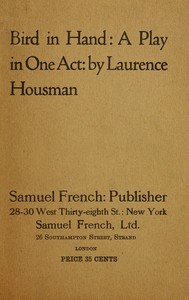
This digital edition of Bird in hand — Edition Insights is described by source-level measurements including 10,139 words, 45 min estimated reading time, and 5 detected text sections.
The text analysis averages about 15.1 words per sentence, while the detected sections provide another way to judge how the source is divided.
Project Gutenberg metadata also associates the work with “One-act plays,” connecting these edition facts with the source record’s subject description.
Explore this collection
These alternatives are selected using recorded categories and estimated reading time.
About 42 minutes
Fantasy Juvenile Worlds
9,466 recorded words. 3 minutes difference from this book's estimate.
View Gutenberg source #50153About 37 minutes
Fantasy Juvenile Worlds
8,493 recorded words. 8 minutes difference from this book's estimate.
View Gutenberg source #29224About 36 minutes
Fantasy Juvenile Worlds
8,229 recorded words. 9 minutes difference from this book's estimate.
View Gutenberg source #52333Search stored excerpts and compare books → Choose by your preferences →
Choices use stored catalog measurements. Estimates vary with reading speed. A shared category is a catalog label, not a claim that two books have the same argument or literary quality.
Search reads excerpt text stored with this catalog and links to its associated Gutenberg record. The connection is stored in the site database; this tool does not recheck that every excerpt is word-for-word identical to that external record. Excerpt search does not cover every chapter and does not verify historical publication dates.
Catalog snapshot checked: 2026-09-26. Coverage: 90 public books, 90 available source excerpts.
Calculated from edition completeness, EPUB availability, text structure and catalogue metadata. Not a user rating.
Total of 100 points, scaled to a 2.5-5.0 range. Editions with an empty description or a missing EPUB file are not scored.
Public-domain source text
The source text is kept in the dedicated reader, separate from this catalogue record and its commentary.
The play opens with a meticulous stage direction: a study lined with books and specimen cases, a typewriter, a microscope, and a case of stuffed birds. The setting immediately establishes Professor Braintree as a man of science, surrounded by order and precision. The first scene shows him clicking at a typewriter in an affluent dressing-gown, dividing his attention between breakfast and his work. The dialogue soon reveals his encounter with a "horrid little green thing" that spoke to him, setting up a conflict between empirical reason and the inexplicable.
The stage directions are unusually detailed, painting a study that is both a sanctuary and a prison of order. The room is filled with books, specimen cases, and scientific instruments. A skeleton clock of "severe design" and a green-shaded lamp reinforce the atmosphere of rational inquiry. The Professor's dressing-gown is "affluent" with "deep rich tones," hinting at his status. The typewriter, at which he clicks "with portentous gravity," symbolizes his desire to imprint his authority on paper. Yet the green blinds and streaming sunlight soften the space, suggesting that nature—and perhaps the irrational—can intrude.
The exchange between Professor Braintree and Dr. Locum is a masterclass in dramatic irony. The Professor recounts his encounter with a green creature that said "Six, six, six, six, six" after he wondered how many cups of green tea he had drunk. The Doctor, ever the pragmatist, dismisses it as an hallucination induced by overwork and green tea. He advises rest and a prescription. But the Professor insists: "It did such a lot of things—that I could not myself have conceived—and once it actually touched me." The Doctor's responses—"Fatal thing to do, Professor"—reveal his own assumptions, while the Professor's persistence hints at a deeper truth.
The creature, named "Bird-in-Hand" in the dramatis personae, is never fully described. The Professor calls it a "horrid little green thing" with eyes "like a young bird's" and horns. It speaks in numbers and seems to respond to his thoughts. The stage directions note that the Professor's eyes turn toward a chest during his confession, suggesting the creature may be confined there. The play's title, "Bird in Hand," evokes the proverb "a bird in the hand is worth two in the bush," but here the bird is a mysterious entity that challenges the Professor's worldview. The audience is left to wonder whether it is real or a projection of his mind.
As a one-act play, "Bird in Hand" unfolds in real time, with no intermission. The dialogue drives the action, and the tension builds through the Professor's increasingly urgent attempts to convince the Doctor. The play's brevity—estimated at 45 minutes—forces a concentrated focus on the central conflict. The excerpts show a pattern of short, clipped lines, with the Professor's speeches growing longer as he tries to explain. The Doctor's responses are terse and dismissive, creating a rhythm of assertion and denial. The play ends without resolution, leaving the creature's nature ambiguous.
Readers approaching this play should pay close attention to the stage directions, which are as much a character as the dialogue. The setting—a scientist's study—is not just a backdrop but a symbol of the rational order that the green creature disrupts. The play's power lies in its ambiguity: is the creature real, or a symptom of the Professor's aging mind? Housman leaves the question open, inviting readers to weigh the evidence for themselves.
I keep thinking of Laurence Housman’s green creature, that moment in Professor Braintree’s study where certainty falters. There is something about how a single unexplained presence can shift an entire room’s temperature. That same quiet disturbance lingers in A Christmas Tale: in One Act — Key Ideas to Explore, though its visitant wears a gentler guise. Strange, how the smallest threads of wonder tie our winters together.
Use these questions to collect your thoughts before moving on.