About 45 minutes
Bird in hand — Edition Insights
Fantasy Juvenile Worlds
10,139 recorded words. 3 minutes difference from this book's estimate.
View Gutenberg source #70209
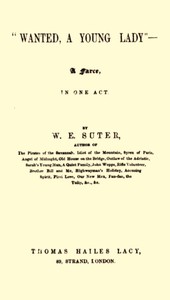
Before opening "Wanted, a Young Lady" : A Farce, in One Act — A Reader’s Guide, the edition data offers a quick orientation: 9,466 words, 42 min estimated reading time, and 4 detected text sections.
The text analysis averages about 13.1 words per sentence, while the detected sections provide another way to judge how the source is divided.
Project Gutenberg metadata also associates the work with “English drama -- 19th century,” connecting these edition facts with the source record’s subject description.
Explore this collection
These alternatives are selected using recorded categories and estimated reading time.
About 45 minutes
Fantasy Juvenile Worlds
10,139 recorded words. 3 minutes difference from this book's estimate.
View Gutenberg source #70209About 37 minutes
Fantasy Juvenile Worlds
8,493 recorded words. 5 minutes difference from this book's estimate.
View Gutenberg source #29224About 36 minutes
Fantasy Juvenile Worlds
8,229 recorded words. 6 minutes difference from this book's estimate.
View Gutenberg source #52333Search stored excerpts and compare books → Choose by your preferences →
Choices use stored catalog measurements. Estimates vary with reading speed. A shared category is a catalog label, not a claim that two books have the same argument or literary quality.
Search reads excerpt text stored with this catalog and links to its associated Gutenberg record. The connection is stored in the site database; this tool does not recheck that every excerpt is word-for-word identical to that external record. Excerpt search does not cover every chapter and does not verify historical publication dates.
Catalog snapshot checked: 2026-09-26. Coverage: 90 public books, 90 available source excerpts.
Calculated from edition completeness, EPUB availability, text structure and catalogue metadata. Not a user rating.
Total of 100 points, scaled to a 2.5-5.0 range. Editions with an empty description or a missing EPUB file are not scored.
Public-domain source text
The source text is kept in the dedicated reader, separate from this catalogue record and its commentary.
W. E. Suter's one-act farce opens with the servant Simon alone on stage, addressing his absent godfather and musing on his comfortable situation: "boarded and lodged and washed, eight pounds a year, and the key of the cellar." This line immediately establishes Simon's fondness for drink—a trait that fuels much of the physical comedy. The stage directions specify a single interior set—an old country mansion with doors on three sides, easy chairs, a couch, and a lighted lamp—creating a confined space where characters repeatedly enter, exit, and misrecognize one another. The play's title, "Wanted, a Young Lady," hints at the central deception: Frank Mitchell, the young male lead, disguises himself as an elderly widow to gain entry to the house, while Adelaide Stirling later appears in an old lady's costume. These quick changes, listed in the costume notes, are essential to the farce's mechanics.
Suter's dialogue relies on brisk exchanges and repeated misunderstandings. Simon's speech is peppered with colloquialisms and malapropisms: he claims he can "sleep quietly on both sides of your face," then admits he "couldn't do it." His line about reddening his nose through access to the cellar becomes a running joke. Frank, in disguise as a widow, responds to Adelaide's criticism of his appearance with "Well, beauty is all a matter of opinion," a line that works both as a deflection and a nod to the gender-bending disguise. The play also uses aside remarks to clue the audience into deceptions: Frank mutters "My grandmother—phew! I should never have known her" when Adelaide enters in old-lady garb. These asides create dramatic irony, as the audience knows more than the characters on stage.
The farce depends heavily on physical actions specified in stage directions. Simon stumbles across the stage, takes a cushion from an easy chair as a pillow, and carries a bottle as a nightcap. Frank rams a scent bottle against Simon's nose and later pushes him offstage. The repeated shaking of the locked door (L.) builds tension and comic effect. Costume changes are integral: Frank enters in a travelling suit, later appears in an old lady's hood, silk gown, shawl, spectacles, and stick, then reverts to his first dress. Adelaide similarly switches from a travelling dress to a silk bonnet, veil, spectacles, shawl, and stick. These transformations happen within the single act, requiring quick backstage work and contributing to the farce's frantic pace.
The play is a one-act farce with a running time of forty minutes, as noted on the title page. The action unfolds in a single interior scene, with entrances and exits through three doors (C., R., L.) and a closet at back. The plot hinges on a series of missed encounters: Frank arrives to find his grandparents away, Simon is left alone, and Adelaide enters disguised. The gate bell rings offstage at a crucial moment, prompting Frank to remark, "Luckily there is no one to be disturbed here." This tight structure—limited setting, small cast, and continuous time—forces characters into rapid confrontations and resolutions. The farce builds to a climax where Frank, still in disguise, is accused of wearing one of Adelaide's gowns, a moment that threatens to expose his ruse.
Several details recur throughout the excerpts. Simon's obsession with the cellar keys and his nose turning red is mentioned multiple times, tying his character to drunkenness. The scent bottle appears twice: first when Frank uses it on Simon, and later when it is placed on the table. The easy chair is a locus of comfort and confusion—Simon sits in it, takes a cushion from it, and later retrieves a bottle from it. The clock is noted at the start ("Seven o'clock!") and time pressure is implied by the evening setting and the lamp. The play also uses the motif of letters or messages: Adelaide mentions a letter from "Dunstable" about the companion, suggesting off-stage correspondence drives the plot. These small, repeated elements give the farce a cohesive texture.
Readers approaching this farce should pay attention to the stage directions, which are as essential as the dialogue. The costume changes and physical business are not mere embellishments but the engine of the comedy. Suter's play is best appreciated as a performance text, where timing and sight gags carry the humor. The excerpts suggest a tight, energetic piece that rewards attention to verbal and physical detail alike.
Sometimes a farce’s frantic disguises remind me of the older stagecraft in A Select Collection of Old English Plays, Volume 07 — Text and Context. Both trust that a slammed door or a quick-swapped coat can say what words cannot. They share a patient mischief, a wink across the centuries. I find that quiet kinship comforting, like meeting an old friend’s grandchild.
Use these questions to collect your thoughts before moving on.