About 37 minutes
The Group: A Farce — Context and Discussion
Fantasy Juvenile Worlds
8,493 recorded words. 1 minutes difference from this book's estimate.
View Gutenberg source #29224
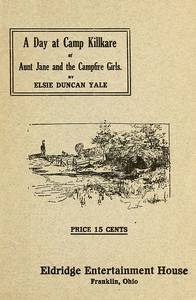
A Day at Camp Killkare; Or, Aunt Jane and the Campfire Girls — Reading Companion can be approached with a clearer sense of reading commitment from its source measurements: 8,229 words, 36 min estimated reading time, and 7 detected text sections.
The text analysis averages about 15.5 words per sentence, while the detected sections provide another way to judge how the source is divided.
Project Gutenberg metadata also associates the work with “Camping -- Drama,” connecting these edition facts with the source record’s subject description.
Explore this collection
These alternatives are selected using recorded categories and estimated reading time.
About 37 minutes
Fantasy Juvenile Worlds
8,493 recorded words. 1 minutes difference from this book's estimate.
View Gutenberg source #29224About 32 minutes
Fantasy Juvenile Worlds
7,241 recorded words. 4 minutes difference from this book's estimate.
View Gutenberg source #61613About 42 minutes
Fantasy Juvenile Worlds
9,466 recorded words. 6 minutes difference from this book's estimate.
View Gutenberg source #50153Search stored excerpts and compare books → Choose by your preferences →
Choices use stored catalog measurements. Estimates vary with reading speed. A shared category is a catalog label, not a claim that two books have the same argument or literary quality.
Search reads excerpt text stored with this catalog and links to its associated Gutenberg record. The connection is stored in the site database; this tool does not recheck that every excerpt is word-for-word identical to that external record. Excerpt search does not cover every chapter and does not verify historical publication dates.
Catalog snapshot checked: 2026-09-26. Coverage: 90 public books, 90 available source excerpts.
Calculated from edition completeness, EPUB availability, text structure and catalogue metadata. Not a user rating.
Total of 100 points, scaled to a 2.5-5.0 range. Editions with an empty description or a missing EPUB file are not scored.
Public-domain source text
The source text is kept in the dedicated reader, separate from this catalogue record and its commentary.
Elsie Duncan Yale's A Day at Camp Killkare; Or, Aunt Jane and the Campfire Girls (1915) is a one-act play built on brisk, teasing dialogue and precise stage directions. The text opens with detailed scenic instructions—trees, a tent, a hammock with bright cushions, a sketching outfit, and a Kodak—that establish a deliberately crafted outdoor setting. The campers wear middy blouses and short skirts, while the visiting Aunt Jane (Miss Pickett) arrives in motoring costume, carrying a lorgnette. These visual contrasts immediately signal the generational and cultural gap that drives the comedy.
Yale uses rapid-fire exchanges to define each camper's personality. When Miss Pickett boasts of walking three blocks to market, Ruth counters with a butcher joke about spoiled lamb, and Betty retorts, “we can’t give you a credit for hiking on the strength of three blocks to the butchers’.” The girls then list their activities—hiking, swimming, drill—only for Betty to interrupt with “Dinner!” The rhythm of interruption and punchline reveals a group comfortable with verbal sparring. Later, Kitty claims Ruth “can make an omelet for ten people with two eggs and a bicycle pump,” a hyperbolic line that underscores the girls' pride in their resourcefulness. Each character's voice is distinct: Hilda is earnest about basketry, Lucille dryly observes, and Miss Pickett alternates between shock (“How dreadful”) and grudging admiration.
The stage directions reveal a practical approach to amateur production. The play can be performed indoors or out: “small trees or leafy branches placed in buckets of sand” substitute for woods, and the floor is covered with brown denim, leaves, and pine needles. Props are minimal but functional—a hammock, camp stools, a Kodak. The tent need only be partially visible. This economy extends to the script's structure: the entire action unfolds in a single scene, with offstage sounds (Hope calling about a spider on the custard) expanding the world without additional sets. The final prop—a tin can fastened to Betty's blouse as a mock Carnegie medal—is a cheap, visible gag that caps the teasing tone.
The play's humor often derives from exaggerated kitchen mishaps. Offstage, Hope announces a spider on the custard, a dozen ants in the sugar bowl, and a toad that “jumped right in the middle of the meringue.” Each crisis is met with a practical solution: “Pick it out,” “I’ll smooth it over, it will never show.” The audience knows these are staged for Miss Pickett's benefit—Betty later assures her the girls are “only teasing.” Yet the jokes also affirm the campers' competence: they can handle (or fake) adversity with aplomb. The running gag about cold lamb chops (Ruth's aside: “Those chops will be stone cold”) anchors the humor in real-world consequences, keeping the fantasy grounded.
Miss Pickett begins as a skeptical outsider, shocked by ants and toads, but her transformation is signaled through small concessions. She admits to being hungry, calls the girls' work “very creditable,” and finally offers to let Lucille stay at camp, sending for suitable clothes. The play's climax is the “Wohelo call”—the Camp Fire Girls' cheer—given after Betty proposes “Three cheers for Aunt Jane.” Yale does not show Miss Pickett's full conversion; the excerpts end with her unfinished speech about “kindly deeds.” The arc is implied through action rather than statement, leaving the audience to infer that the camp's spirit has won her over. This restraint keeps the character believable within the one-act format.
Readers approaching this play should attend to its dual life as both a script for performance and a period document of the Camp Fire Girls movement. The dialogue rewards reading aloud, and the stage directions offer a clear blueprint for staging. Yale's choices in diction—the girls' slang, Miss Pickett's formalisms—and her use of offstage sound create a compact, lively world. The play's humor depends on shared cultural knowledge of early twentieth-century domestic life, but its structure remains accessible to modern readers interested in theatrical craft or the history of youth organizations.
There’s something touching about Aunt Jane’s stubborn warmth slowly melting over that campfire—how the girls’ chaos becomes its own kind of grace. It reminded me of quieter evenings spent with Poetical Works of Robert Bridges, Volume 4 — Reading Companion, where patience in verse feels just as alive. Funny how old voices still hold a little light for us.
Capture what you thought, learned, and would like to remember.