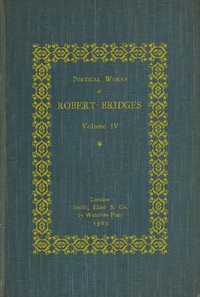
Robert Bridges's Poetical Works, Volume 4 contains two substantial verse dramas that showcase his interest in blending dramatic traditions. Palicio, subtitled 'A Romantic Drama in Five Acts in the Elizabethan manner,' is set in Palermo during the Spanish occupation of Sicily. Its opening dialogue between Blasco and Ferdinand immediately establishes a world of political tension and banditry, with Blasco's remark that the people are 'subject to fermentation, and like good wine / Ever the better for it' revealing a wry, colloquial voice. The Return of Ulysses, described as 'A Drama in Five Acts in a mixed manner,' draws directly on Homer, but Bridges gives the hero a wary, psychologically nuanced interiority. The excerpts show Bridges varying his verse pace: rapid, stichomythic exchanges in Palicio contrast with the longer, more meditative speeches of Ulysses.
Elizabethan Echoes and Sicilian Strife
In Palicio, Bridges adopts the structure and rhetorical gestures of Elizabethan drama. The play opens in medias res with two minor characters, Blasco and Ferdinand, whose conversation supplies exposition about the Viceroy Hugo's unpopularity and the lawless state of Sicily. The verse is predominantly iambic pentameter, with frequent use of end-stopped lines and occasional rhyme for emphasis. Bridges employs a deliberately archaic vocabulary—'daintiest pricking,' 'plunged in disesteem'—that signals his debt to Shakespeare and his contemporaries. Yet the setting is not merely decorative: the Spanish occupation provides a backdrop of colonial tension, and the bandit Palicio, though not yet named in the excerpt, looms as a figure of popular resistance. The dialogue moves briskly, with short speeches that create a sense of urgency and conspiracy.
Ulysses and the Weight of Memory
In The Return of Ulysses, Bridges slows the pace considerably. The excerpt from Act I shows Ulysses in conversation with Athena, but his responses are hesitant, even fearful. He recalls the warning of Tiresias and the murder of Agamemnon, and he refuses to rush home: 'I would not enter in my house, / Nay, nor be known of any, till I hear / Such tidings as bespeak my coming well.' This cautious, almost paranoid Ulysses is a departure from the Homeric original. Bridges gives him a psychological depth that emerges through long, reflective speeches. The verse here is more fluid, with enjambment and caesurae that mimic natural speech rhythms. Athena's replies are crisp and directive, creating a contrast between divine certainty and human doubt. The excerpt also includes a vivid description of the suitors as a besieging army, a simile that extends over several lines and demonstrates Bridges's control of epic comparison.
Shifts in Voice and Metre
Across the two plays, Bridges varies his poetic voice to suit genre and character. In Palicio, the dialogue is often clipped and argumentative, with characters interrupting each other and finishing each other's lines. Blasco's speech is laced with proverbial wit—'a hot-blooded race, sir, full of stirrings'—while Ferdinand's is more formal and critical. In The Return of Ulysses, the tone is more elevated, with longer periods and a statelier rhythm. Ulysses's speeches are introspective, full of conditional clauses and rhetorical questions: 'If strong desire / Could ever conquer me, now should I do / A thing for which no man might blame me.' Bridges also uses metrical variation for emphasis: trochaic inversions at the start of lines, or a sudden spondee to stress a key word. The notes at the end of the volume, though not excerpted, likely discuss these technical choices, as Bridges was a noted prosodist.
Readers approaching this volume will find two distinct dramatic experiments. Palicio rewards attention to its political subtext and its manipulation of Elizabethan conventions, while The Return of Ulysses offers a more intimate, psychological reading of the Homeric hero. Bridges's verse demands careful reading aloud to appreciate its rhythmic shifts. The volume also includes extensive notes, which may illuminate his sources and metrical theories. For those interested in late-Victorian verse drama, this collection provides a valuable example of a poet working to revitalize classical and Renaissance forms.
Reading Bridges’s Palicio the other evening, with its Spanish setting and uneasy silences between characters, I kept thinking of Marston’s own tangled dramaturgy. Both feel like rooms where people speak past each other. That odd, almost bitter formality in Bridges reminded me of something familiar, and I found myself reaching for The Works of John Marston. Volume 3 — Background and Themes, which had always struck me the same way.