About 247 minutes
Poetical Works of Robert Bridges, Volume 4 — Reading Companion
Fantasy Juvenile Worlds
56,749 recorded words. 39 minutes difference from this book's estimate.
View Gutenberg source #56266
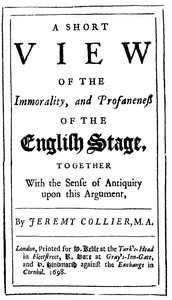
For A Short View of the Immorality, and Profaneness of the English Stage Together with the Sense of Antiquity on this Argument — A Closer Reading, the stored edition analysis reports 65,575 words, 4 hr 46 min estimated reading time, and 12 detected text sections.
The text analysis averages about 16.6 words per sentence, while the detected sections provide another way to judge how the source is divided.
Project Gutenberg metadata also associates the work with “Theater -- Moral and ethical aspects -- Early works to 1800,” connecting these edition facts with the source record’s subject description.
Explore this collection
These alternatives are selected using recorded categories and estimated reading time.
About 247 minutes
Fantasy Juvenile Worlds
56,749 recorded words. 39 minutes difference from this book's estimate.
View Gutenberg source #56266About 201 minutes
Fantasy Juvenile Worlds
46,056 recorded words. 85 minutes difference from this book's estimate.
View Gutenberg source #8500About 185 minutes
Fantasy Juvenile Worlds
42,356 recorded words. 101 minutes difference from this book's estimate.
View Gutenberg source #68430Search stored excerpts and compare books → Choose by your preferences →
Choices use stored catalog measurements. Estimates vary with reading speed. A shared category is a catalog label, not a claim that two books have the same argument or literary quality.
Search reads excerpt text stored with this catalog and links to its associated Gutenberg record. The connection is stored in the site database; this tool does not recheck that every excerpt is word-for-word identical to that external record. Excerpt search does not cover every chapter and does not verify historical publication dates.
Catalog snapshot checked: 2026-09-26. Coverage: 90 public books, 90 available source excerpts.
Calculated from edition completeness, EPUB availability, text structure and catalogue metadata. Not a user rating.
Total of 100 points, scaled to a 2.5-5.0 range. Editions with an empty description or a missing EPUB file are not scored.
Public-domain source text
The source text is kept in the dedicated reader, separate from this catalogue record and its commentary.
Jeremy Collier opens his 1698 attack on the English stage with a blunt accusation: the playwrights have debauched the age. His preface sets a combative tone, describing the stage poets as thieves who not only rob but murder, because they destroy principles along with morals. Collier’s method is forensic: he collects examples from plays, quotes classical authorities, and challenges the reasoning of his opponents, especially John Dryden. The work is structured as a series of arguments, each targeting a different aspect of theatrical immorality—profaneness, lewdness, and the failure to punish vice. Collier’s own prose is sharp and sardonic, often mimicking the rhythms of the plays he condemns.
Collier’s argumentative voice is distinctive: he combines the authority of a moralist with the precision of a textual critic. In the preface, he declares that “to have no good Principles, is to have no Reason to be Good,” a maxim that frames his entire case. He frequently uses metaphors of violence and theft, calling the playwrights “Foot-Pads” who “Rob, but Murther.” This language is not incidental; it reflects his view that the stage is an active agent of corruption. Collier also employs irony, as when he notes that the poets’ “Measures are Politickly taken” to destroy conscience. His sentences are often long and periodic, building a rhythm of accusation before delivering a punchy verdict. The effect is a prose that feels both learned and combative, designed to persuade through reason and indignation.
Collier’s method relies heavily on close reading of specific plays, particularly those of Ben Jonson. He disputes Dryden’s claim that Jonson’s The Alchemist leaves vice unpunished, arguing that Face’s apology and confession show the poet’s care to “prevent the Ill Impressions of his Play.” Collier quotes the play’s ending, noting that Face “sets himself at the Bar, arraign his own Practise, and cast the Cause upon the Clemency of the Company.” This attention to dramatic structure—how a character’s final speech shapes moral meaning—is central to Collier’s critique. He similarly defends Jonson’s The Silent Woman, arguing that Dauphine is not as “naughty” as Dryden claims, because he appears “tired, and willing to disengage” from the collegiate ladies. These readings show Collier as a careful, if partisan, interpreter of dramatic texts.
Collier grounds his argument in the “Sence of Antiquity,” citing Aristotle, Horace, and the Church Fathers. He argues that Horace’s advice to follow “the Precepts of Socrates and Plato” obliges poets to “Sobriety of Conduct, and a just distribution of Rewards, and Punishments.” This appeal to classical precedent is not merely decorative; it provides a standard against which modern plays are measured. Collier also engages with the history of comedy, noting that the chorus was present in Aristophanes and that Moliere revived it. His use of marginal notes and footnotes (here converted to endnotes) shows a scholarly apparatus intended to bolster his credibility. However, his classical learning is always in service of a contemporary polemic: the ancients are invoked to condemn the Restoration stage.
Collier’s Short View is best read as a work of moral criticism that repays attention to its rhetorical texture and its specific engagements with plays. Readers interested in the history of literary criticism will find here a model of how close reading can serve ideological ends. The excerpts suggest that Collier’s arguments are more nuanced than a simple condemnation: he is willing to defend Jonson against Dryden, and he uses classical sources with care. The full text likely extends these techniques across a wider range of plays and authors, offering a sustained case for the stage’s reform.
Reading Collier’s quiet fury—how he lingers on a single profane word until it feels heavy—made me think of how some arguments echo past their moment. The Group: A Farce — Context and Discussion held that same strange weight for me, a small piece of stage history still humming with unanswered questions. It stayed long after I closed it.
A brief reflection can help important ideas stay with you longer.