About 201 minutes
Plays: Comrades; Facing Death; Pariah; Easter — Inside the Classic
Fantasy Juvenile Worlds
46,056 recorded words. 16 minutes difference from this book's estimate.
View Gutenberg source #8500
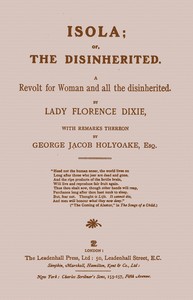
For Isola; or, The disinherited: A revolt for woman and all the disinherited — Themes and Context, the stored edition analysis reports 42,356 words, 3 hr 5 min estimated reading time, and 15 detected text sections.
The text analysis averages about 16.7 words per sentence, while the detected sections provide another way to judge how the source is divided.
Project Gutenberg metadata also associates the work with “Women's rights -- Drama,” connecting these edition facts with the source record’s subject description.
Explore this collection
These alternatives are selected using recorded categories and estimated reading time.
About 201 minutes
Fantasy Juvenile Worlds
46,056 recorded words. 16 minutes difference from this book's estimate.
View Gutenberg source #8500About 154 minutes
Fantasy Juvenile Worlds
35,198 recorded words. 31 minutes difference from this book's estimate.
View Gutenberg source #3820About 148 minutes
Fantasy Juvenile Worlds
33,861 recorded words. 37 minutes difference from this book's estimate.
View Gutenberg source #13039Search stored excerpts and compare books → Choose by your preferences →
Choices use stored catalog measurements. Estimates vary with reading speed. A shared category is a catalog label, not a claim that two books have the same argument or literary quality.
Search reads excerpt text stored with this catalog and links to its associated Gutenberg record. The connection is stored in the site database; this tool does not recheck that every excerpt is word-for-word identical to that external record. Excerpt search does not cover every chapter and does not verify historical publication dates.
Catalog snapshot checked: 2026-09-26. Coverage: 90 public books, 90 available source excerpts.
Calculated from edition completeness, EPUB availability, text structure and catalogue metadata. Not a user rating.
Total of 100 points, scaled to a 2.5-5.0 range. Editions with an empty description or a missing EPUB file are not scored.
Public-domain source text
The source text is kept in the dedicated reader, separate from this catalogue record and its commentary.
Lady Florence Dixie's Isola; or, The disinherited (1877) is a verse drama that announces its polemical intent from the first preface: it demands 'Justice for all living things' and 'the Reign of Truth and the destruction of Humbug.' The play is set in an imaginary kingdom, but its concerns are pointedly contemporary, targeting the legal and religious subordination of women. Dixie's diction is blunt and combative, and her characters often speak in long, argumentative speeches that read more like manifestos than dialogue. The drama was serialized in Young Oxford in 1902, decades after its original composition, suggesting the author's sustained commitment to its themes.
Dixie's language is consistently confrontational. The preface declares the play 'a revolt for woman and all the disinherited,' and the text itself is filled with accusations against established power. In one passage, the character Sanctimonious—a name that signals the author's contempt—describes the threat of women awakening to their equality as a 'rolling wave of unbelief' that will 'sweep us off our noble legs.' The metaphor is deliberately violent, and the speaker's panic is rendered in exclamatory, breathless lines: 'We are undone! Alas! we are undone!' Dixie does not aim for subtlety; her characters are often mouthpieces for opposing ideologies, and their speeches are structured as direct attacks on religious and civil institutions.
The plot is driven by a conspiracy to assassinate the reformer Vergli and his allies. In the excerpt, Chief Peerer Conception reports to Sanctimonious that he has hired the assassin Judath, who 'gleamed like a coal' and spoke with 'the cunning of the fox.' The price on Vergli's head is twenty thousand crowns, with lower sums for his associates. This mercenary subplot is rendered in vivid, almost grotesque physical detail: Judath's 'yellow teeth grinned' as he promised to deliver the bodies before winter. The conspirators' dialogue is laced with cynical laughter—'ha, ha'—and a casual amorality that contrasts sharply with the reformers' earnestness. Dixie uses this contrast to heighten the stakes of the ideological conflict.
A central target of Dixie's critique is the religious justification for women's subordination. Sanctimonious explicitly outlines the doctrine: 'Man being fashioned in the shape of God, / Is naturally the Superior Life, / And Woman, but a bauble After Thought, / Made for Man's Comfort, and his Pleasure too.' The speech reduces women to 'slave, / As wife obedient, or as prostitute.' Dixie places this argument in the mouth of a villain, allowing her to expose and condemn it without authorial intrusion. The character Vergli, by contrast, is said to 'preach a lie' by proclaiming women equal. The play thus stages a theological debate in verse, using the imaginary setting to critique real-world religious dogma.
Dixie's choice of verse is itself a rhetorical strategy. The play is written in blank verse, with occasional rhymed couplets, and the lines are often end-stopped, giving each statement a declarative weight. Speeches run for dozens of lines without interruption, functioning as set-piece arguments. The diction mixes formal poetic language—'Lo! sinks the sun beneath the Bawn co Pagh'—with colloquial exclamations like 'Great Scot!' This uneven register suggests a writer more concerned with persuasion than with stylistic polish. The verse form also allows Dixie to compress complex political arguments into memorable, quotable lines, such as 'Thought is Life. It cannot die.' The drama is less a play for performance than a printed polemic in poetic form.
The volume includes remarks by George Jacob Holyoake, a noted secularist and social reformer. His presence as commentator signals the play's alignment with freethought and radical politics. Holyoake's endorsement—he is praised in the dedication for his 'long and courageous fight against superstition, injustice, and oppression'—lends the work an air of intellectual seriousness. The inclusion of his commentary also suggests that Dixie intended the play to be read as part of a broader reformist conversation, not merely as a literary exercise. The reader should consider how Holyoake's remarks frame the drama and whether they reinforce or complicate its arguments.
Readers approaching Isola should be prepared for a work that prioritizes argument over action. The characters are largely vehicles for ideas, and the plot is secondary to the debates they conduct. Pay attention to the way Dixie uses the imaginary setting to distance her critique while simultaneously making it more pointed. The verse can be uneven, but its energy and conviction are unmistakable. This is a document of late-Victorian radicalism, and its value lies as much in its historical context as in its literary qualities.
I keep thinking about how Dixie’s verse drama turns a far-off kingdom into a mirror for our own quiet rebellions. It made me remember reading the old Webster plays—how their darkness felt less like doom and more like a held breath. There’s something similar in Webster & Tourneur — Edition Insights, a lingering ache that stays after the page closes. I just sat with that feeling for a while.
A brief reflection can help important ideas stay with you longer.