About 439 minutes
The Works of John Marston. Volume 3 — Background and Themes
Fantasy Juvenile Worlds
100,778 recorded words. 35 minutes difference from this book's estimate.
View Gutenberg source #46312
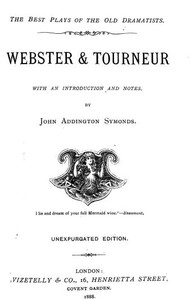
Webster & Tourneur — Edition Insights can be approached with a clearer sense of reading commitment from its source measurements: 108,833 words, 7 hr 54 min estimated reading time, and 13 detected text sections.
The text analysis averages about 13.9 words per sentence, while the detected sections provide another way to judge how the source is divided.
Project Gutenberg metadata also associates the work with “English drama -- 17th century,” connecting these edition facts with the source record’s subject description.
Explore this collection
These alternatives are selected using recorded categories and estimated reading time.
About 439 minutes
Fantasy Juvenile Worlds
100,778 recorded words. 35 minutes difference from this book's estimate.
View Gutenberg source #46312About 538 minutes
Fantasy Juvenile Worlds
123,696 recorded words. 64 minutes difference from this book's estimate.
View Gutenberg source #10336About 286 minutes
Fantasy Juvenile Worlds
65,575 recorded words. 188 minutes difference from this book's estimate.
View Gutenberg source #44645Search stored excerpts and compare books → Choose by your preferences →
Choices use stored catalog measurements. Estimates vary with reading speed. A shared category is a catalog label, not a claim that two books have the same argument or literary quality.
Search reads excerpt text stored with this catalog and links to its associated Gutenberg record. The connection is stored in the site database; this tool does not recheck that every excerpt is word-for-word identical to that external record. Excerpt search does not cover every chapter and does not verify historical publication dates.
Catalog snapshot checked: 2026-09-26. Coverage: 90 public books, 90 available source excerpts.
Calculated from edition completeness, EPUB availability, text structure and catalogue metadata. Not a user rating.
Total of 100 points, scaled to a 2.5-5.0 range. Editions with an empty description or a missing EPUB file are not scored.
Public-domain source text
The source text is kept in the dedicated reader, separate from this catalogue record and its commentary.
The 1888 Mermaid Series edition of Webster & Tourneur, edited by John Addington Symonds, opens with a detailed description of the Globe Theatre—its hexagonal shape, thatched roof, and the flag bearing St. George's cross. This historical note immediately situates the plays within a specific performance context, emphasizing daylight staging and the absence of scenery. Symonds's introduction then confesses that almost nothing is known about the playwrights' lives, a frank acknowledgment that shapes how readers approach the works: without biographical clues, the texts themselves become the primary evidence. The edition includes four plays—The White Devil, The Duchess of Malfi, The Atheist's Tragedy, and The Revenger's Tragedy (the latter now attributed to Thomas Middleton, as a transcriber's note observes). This collection invites comparison across the two authors, while the editorial apparatus offers a framework for first-time readers.
Symonds's introduction, titled "John Webster and Cyril Tourneur," begins with a striking admission: "Nothing is known about the lives of John Webster and Cyril Tourneur. We are ignorant when they were born and when they died." This opening establishes a tone of scholarly humility, steering readers away from biographical speculation and toward the plays themselves. The editor provides only "meagre hints of what contemporaries thought of them," suggesting that the works must stand on their own. For a first reading, this frame is liberating: it encourages attention to the language, structure, and recurring motifs rather than authorial intent. Symonds also includes explanatory notes at the end of the volume, which gloss archaic terms and historical references without overwhelming the text. Readers new to these plays may find it useful to consult the notes sparingly, allowing the dialogue's rhythm to carry them forward before seeking clarification.
The first play, The White Devil, begins with a scene that immediately establishes a world of political intrigue and moral ambiguity. The excerpt shows Lodovico, recently banished, railing against his fate in language that mixes venomous invective with a kind of weary grandeur. His opening line—"Banish'd!"—sets a tone of dispossession and revenge. The dialogue is dense with classical allusions and legal terminology, reflecting the play's concern with justice and corruption. A first-time reader should note how Webster uses short, punchy exchanges to convey urgency, contrasted with longer, more reflective speeches that reveal character. The scene also introduces a network of spies and informants, a motif that recurs throughout the play. Pay attention to how characters manipulate language: promises are made and broken, and oaths are treated as currency. This opening primes the reader for a world where trust is a liability and words are weapons.
In The Duchess of Malfi, the excerpt presents a pivotal scene where the Duchess, a widow, proposes marriage to her steward Antonio. Her directness—"I am Duchess of Malfi still"—asserts her authority even as she defies social norms. The dialogue reveals a sharp contrast between her openness and the conspiratorial whispers of her brothers, the Cardinal and Ferdinand. Webster uses the imagery of light and darkness to underscore this tension: the Duchess speaks in the daylight of honest emotion, while her brothers scheme in shadows. For a first reading, note how the Duchess's agency challenges the period's expectations of female characters. Her proposal is both a declaration of love and a political act, blending the personal and the public. The scene also introduces the theme of surveillance, as the brothers employ spies to monitor her actions. This motif of watching and being watched recurs throughout the play, creating an atmosphere of paranoia that the reader must navigate alongside the characters.
The volume includes two plays by Cyril Tourneur (with The Revenger's Tragedy now attributed to Middleton). In The Atheist's Tragedy, the opening scenes present a philosophical debate about divine justice, with the atheist D'Amville arguing that death is the end of consciousness. The language is more overtly didactic than Webster's, with characters often serving as mouthpieces for competing worldviews. A first-time reader may notice how Tourneur uses legal and theological vocabulary to structure arguments, creating a sense of intellectual combat. The Revenger's Tragedy, by contrast, opens with a soliloquy in which Vindici holds the skull of his poisoned lady, addressing it with bitter irony. The image of the skull—a memento mori—sets the play's tone of macabre satire. Both plays share a preoccupation with mortality and corruption, but their approaches differ: Tourneur leans toward allegory, while Middleton (in the reattributed play) favors grotesque humor. Reading these alongside Webster's more psychologically complex dramas highlights the range of early modern tragedy.
This edition offers a rare opportunity to compare two playwrights who, despite sharing a historical moment, developed distinct dramatic voices. Symonds's editorial choices—the Globe Theatre description, the biographical disclaimer, the unexpurgated text—invite readers to engage with the plays as living documents rather than museum pieces. For a first reading, let the language guide you: Webster's dense, image-laden verse and Tourneur's more argumentative style each demand different kinds of attention. The notes are there when needed, but the plays themselves reward patience and rereading.
That rain fell hard against the window while Symonds’s notes guided me through Webster’s shadowed courts—all that doomed ambition pressing close. Later, flipping pages, I landed on the Flemish occupation’s quieter, stranger grief. The tyranny felt familiar, but slowed, almost domestic. The Sorrows of Belgium: A Play in Six Scenes — Background and Themes sat beside me, and the afternoon simply carried us both along.
Use these questions to collect your thoughts before moving on.