eBooks
90 Books foundAbout the ILIJU Public Domain Literature Library
This catalogue offers a curated selection of 90 public-domain works, primarily drawn from the Project Gutenberg collection. The focus is on plays, dramatic poems, and theatrical histories spanning the 15th to early 20th centuries, with a smaller number of verse collections and biographical works. Each record provides bibliographic details, subject keywords, and a contextual note prepared as supplementary catalogue material, to help readers approach the text with informed curiosity.
Browsing and Discovery
Readers can explore the catalogue in three ways. The main archive page lists all works alphabetically by title, with basic metadata. Category pages group works by thematic affinity into four areas: Poetry, Drama & Performance; Conflict, Power & Social Change; History, Empires & Change; and Historical Psychological Social Fiction. Each category guide explains why the works cohere and offers three recommendations with specific reasons. Additionally, the editorial standards page describes the principles behind the catalogue's creation.
What a Book Record Contains
Every entry includes the title, author(s), digital source (Project Gutenberg), subject keywords, a target-reader note, and a catalogue note. The catalogue note is a short editorial observation that highlights structural patterns, stylistic choices, or thematic concerns, but it does not summarize the plot or claim comprehensive analysis. Internal links connect to the full text on Project Gutenberg.
Source Attribution
All works are sourced from Project Gutenberg, a digital library of public-domain texts. The catalogue does not host or modify the texts; it provides a guided pathway to them. The edition information (such as translator, editor, or publisher) is reproduced as given in the source metadata.
Three Reading Paths
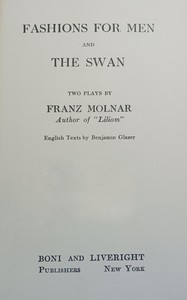
For a broad introduction to drama across cultures, begin with Arthur Waley's The Nō Plays of Japan (category 1), followed by Chekhov's Uncle Vanya (category 4), and Ferenc Molnár's Fashions for Men (category 3). To explore works centered on political conflict, try Gotthold Ephraim Lessing's Nathan the Wise (category 2), Mordecai Manuel Noah's She Would Be a Soldier (category 3), and Elizabeth Baker's Chains (category 4). For a sequence focused on performance and theatrical history, read Dr. John Doran's Annals of the English Stage (Volume 1, category 1), Owen Davis's memoir I'd Like to Do It Again (category 4), and the one-act collection Contemporary One-Act Plays (category 4).
Categories as Navigation Aids
The four category labels are not definitive literary judgments but practical groupings meant to help readers find works that share a discernible emphasis. Some works could reasonably fit into more than one category; the assignment is based on the most prominent feature noted in the catalogue entry. Readers are encouraged to browse across categories.
Practical Usage
All catalogue pages are designed for straightforward reading. Category guides include recommended works with reasons, and each book page offers a direct link to the text. For questions or suggestions, contact the catalogue project via the site's contact page.
Bibliographic dates and catalogue measurements
The catalogue distinguishes the Project Gutenberg digital release from a work’s original or first publication. Project Gutenberg is identified as the digital source for the edition available here; its release year is therefore shown as Gutenberg Release Year, not as the work’s original publication year.
When an explicit first-publication or issue date can be supported directly by the title or issue information, it may be shown separately as First Publication Year. When that date cannot be confirmed, the catalogue displays Not confirmed rather than guessing a year.
Where the source text can be measured reliably, the catalogue may provide word count and estimated reading time. These measurements describe reading scope and are not quality rankings.
The current catalogue contains 4 active subject categories: Adventure Picaresque Fiction, Fantasy Juvenile Worlds, Science Fiction Utopias, and Historical Psychological Social Fiction. Categories are browsing aids and may overlap where a work reasonably fits more than one subject.
- Featured