About 185 minutes
Three Plays: The Fiddler's House, The Land, Thomas Muskerry — Reading Notes
Science Fiction Utopias
42,482 recorded words. 73 minutes difference from this book's estimate.
View Gutenberg source #11878
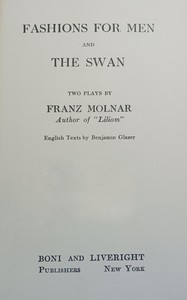
For Fashions for men, and The swan — Key Ideas to Explore, the stored edition analysis reports 59,238 words, 4 hr 18 min estimated reading time, and 16 detected text sections.
The text analysis averages about 7.6 words per sentence, while the detected sections provide another way to judge how the source is divided.
Project Gutenberg metadata also associates the work with “Comedy plays,” connecting these edition facts with the source record’s subject description.
Explore this collection
These alternatives are selected using recorded categories and estimated reading time.
About 185 minutes
Science Fiction Utopias
42,482 recorded words. 73 minutes difference from this book's estimate.
View Gutenberg source #11878About 161 minutes
Science Fiction Utopias
36,840 recorded words. 97 minutes difference from this book's estimate.
View Gutenberg source #15298About 144 minutes
Science Fiction Utopias
32,972 recorded words. 114 minutes difference from this book's estimate.
View Gutenberg source #35389Search stored excerpts and compare books → Choose by your preferences →
Choices use stored catalog measurements. Estimates vary with reading speed. A shared category is a catalog label, not a claim that two books have the same argument or literary quality.
Search reads excerpt text stored with this catalog and links to its associated Gutenberg record. The connection is stored in the site database; this tool does not recheck that every excerpt is word-for-word identical to that external record. Excerpt search does not cover every chapter and does not verify historical publication dates.
Catalog snapshot checked: 2026-09-26. Coverage: 90 public books, 90 available source excerpts.
Calculated from edition completeness, EPUB availability, text structure and catalogue metadata. Not a user rating.
Total of 100 points, scaled to a 2.5-5.0 range. Editions with an empty description or a missing EPUB file are not scored.
Public-domain source text
The source text is kept in the dedicated reader, separate from this catalogue record and its commentary.
Ferenc Molnár's paired plays, translated by Benjamin Glazer, present two sharply different theatrical worlds. In Fashions for Men, the action centers on a small shop cluttered with cravats, suspenders, and perfume bottles, where the cash register and display window anchor a domestic comedy of manners. The cast list alone—Aristocratic Lady, Unassuming Lady, Nervous Gentleman—signals a social microcosm played out in a cramped commercial space. By contrast, The Swan opens in a sunlit garden pavilion used as a classroom for young princes, where a lecture on Napoleon's exile immediately establishes a tone of political reflection and dynastic anxiety. The two plays share Molnár's ear for dialogue but diverge in setting and pace: one bustling with customers and creditors, the other measured by royal protocol and historical allusion.
Fashions for Men derives its energy from the physical constraints of its setting. The stage directions map a precise geography: display window down left, cashier's desk between window and entrance, counters along back and right walls, a balcony overhead, and an archway leading to a rear room. This layout forces characters into constant proximity, making every entrance and exit a potential collision. The opening scene lists a table with open boxes of cravats, suspenders, ladies' girdles, colored scarfs, and bottles of perfume—items that define the shop's trade and hint at the mingling of male and female clientele. Dialogue moves briskly, interrupted by the cash register's ring and the delivery boy's arrivals. The play's rhythm is staccato, built on short lines and overlapping demands from customers and family alike. This compressed environment mirrors the protagonist Peter Juhasz's entanglements: his wife Adele, his employees, and his creditors all crowd into the same small stage, leaving no room for private reflection.
The Swan opens with a history lesson that immediately politicizes the classroom. Dr. Agi recounts Napoleon's death on St. Helena, emphasizing Hudson Lowe's petty cruelty in forbidding the word 'Napoleon' on the gravestone. The princes Georg and Arsen respond not with academic detachment but with family grievance: their mother hates Napoleon for his role in their dynasty's dethronement. The dialogue reveals a household where historical interpretation is a battleground. Georg declares the professor's view his own—'Not mine, but the professor's'—while Arsen reports their mother's anger at Agi for not teaching hatred of Napoleon. The lesson becomes a proxy for current anxieties: Prince Albert, an heir-apparent, is visiting, and the mother's sensitivity about thrones colors every discussion. Molnár uses the lecture to establish a world where past and present are inseparable, and where authority is constantly questioned. The pace here is deliberate, the sentences longer, as Agi's measured speech contrasts with the boys' pointed interruptions.
Benjamin Glazer's translations, copyrighted in 1922, render Molnár's Hungarian into an English that balances colloquial ease with period formality. In Fashions for Men, the dialogue favors short, declarative lines that suit the shop's hurried atmosphere. Characters address each other by type—'Aristocratic Lady,' 'Young Gentleman'—rather than name, giving the play a slightly allegorical quality. In The Swan, the language shifts toward the oratorical: Agi's lecture on Napoleon uses phrases like 'protracted physical sufferings' and 'majestically simple bier of stone,' while the princes speak with a precocious formality ('With all deference to her royal highness'). Glazer preserves the distinction between the two plays' registers, allowing the reader to hear Molnár's range. The translation also retains Hungarian naming conventions—Juhasz, Domokos, Santha—that anchor the plays in their original setting. Glazer's work, staged by himself in New York, suggests a hands-on approach to making these plays performable in English.
Reading these two plays together highlights Molnár's versatility as a dramatist. Fashions for Men rewards attention to its stage business—the handling of props, the timing of entrances—while The Swan invites consideration of how its historical references comment on the characters' present. Glazer's translations, now over a century old, offer a window into early twentieth-century theatrical English. Readers may find it useful to compare the pacing of the two works, noting how Molnár adapts his dialogue to different social milieus.
I finished Molnár’s plays feeling oddly tender toward their small, messy people—the shopkeeper clinging to a shop that’s slipping away. It reminded me of the quiet way backstage lives pile up around a single burning ambition. Then I found myself thinking of The Life of David Belasco; Vol. 2 — Background and Themes, how that same tender ache lingers behind the footlights, a softer shadow of the show.
A brief reflection can help important ideas stay with you longer.