About 128 minutes
The Unknown; A Play in Three Acts — Reading Notes
Historical Psychological Social Fiction
29,252 recorded words. 3 minutes difference from this book's estimate.
View Gutenberg source #49771
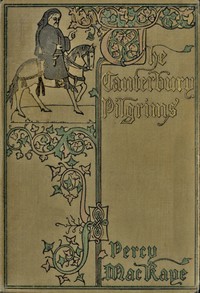
The Canterbury pilgrims — Reading Notes can be approached with a clearer sense of reading commitment from its source measurements: 28,601 words, 2 hr 5 min estimated reading time, and 30 detected text sections.
The text analysis averages about 9.3 words per sentence, while the detected sections provide another way to judge how the source is divided.
Project Gutenberg metadata also associates the work with “American drama -- 20th century,” connecting these edition facts with the source record’s subject description.
Explore this collection
These alternatives are selected using recorded categories and estimated reading time.
About 128 minutes
Historical Psychological Social Fiction
29,252 recorded words. 3 minutes difference from this book's estimate.
View Gutenberg source #49771About 130 minutes
Historical Psychological Social Fiction
29,719 recorded words. 5 minutes difference from this book's estimate.
View Gutenberg source #54014About 131 minutes
Historical Psychological Social Fiction
29,906 recorded words. 6 minutes difference from this book's estimate.
View Gutenberg source #29227Search stored excerpts and compare books → Choose by your preferences →
Choices use stored catalog measurements. Estimates vary with reading speed. A shared category is a catalog label, not a claim that two books have the same argument or literary quality.
Search reads excerpt text stored with this catalog and links to its associated Gutenberg record. The connection is stored in the site database; this tool does not recheck that every excerpt is word-for-word identical to that external record. Excerpt search does not cover every chapter and does not verify historical publication dates.
Catalog snapshot checked: 2026-09-26. Coverage: 90 public books, 90 available source excerpts.
Calculated from edition completeness, EPUB availability, text structure and catalogue metadata. Not a user rating.
Total of 100 points, scaled to a 2.5-5.0 range. Editions with an empty description or a missing EPUB file are not scored.
Public-domain source text
The source text is kept in the dedicated reader, separate from this catalogue record and its commentary.
Percy MacKaye's The Canterbury Pilgrims opens not on the road but at the Tabard Inn in Southwark, where the Host, Bottlejohn, bustles about while pilgrims argue theology and politics. The play's first substantial exchange pits John Wycliffe against Chaucer himself: Wycliffe calls England 'a gorgeous tabard' worn by a 'poor, starved peasant,' while Chaucer counters that England remains 'Merry England,' where nature grants 'mirth, friendship, innocence.' This ideological clash—reform versus merriment—sets the stage for a comedy that uses Chaucer's own characters to explore tensions between piety, pleasure, and social justice.
The excerpts reveal that MacKaye structures his play around a series of confrontations. Wycliffe's entrance provokes both 'shouts of welcome' and 'hisses,' and the dialogue quickly becomes heated: the Monk calls Wycliffe 'unhang'd Lollard,' while the Parson retorts 'Thou son of Antichrist.' The Ploughman, a silent figure among sneers and applause, simply says 'Right!' when Wycliffe condemns the rich. Chaucer, by contrast, offers a gentler theology: 'Mirth, friendship, innocence: / These three, sir, serve for my theology.' This opposition—between Wycliffe's indictment of social injustice and Chaucer's defense of natural joy—drives the opening scenes and likely recurs throughout the play.
Alongside the religious debate, the excerpts introduce a romantic subplot involving Chaucer, the Prioress Eglantine, and a young woman named Johanna. Johanna, who seeks to draw Wycliffe away, calls Chaucer a 'villain' and refuses to speak with him. The Squire pursues her with 'Grace, Madonna, grace!' but she sweeps out. Chaucer then approaches the Prioress, who at first ignores him, instructing her priests to 'Keep close.' When he mentions her brother, she turns shyly and asks 'Vous dites mon frère?'—but Chaucer mutters aside 'Drown her brother.' The Prioress's mix of formality and hidden interest, along with Johanna's hostility, suggests a love triangle that complicates the ideological conflicts.
MacKaye's dialogue blends Chaucerian pastiche with stage comedy. The Host's 'These 'prentices!' and the Cook's 'Ow! Ow! A devil's head!' create a bustling, low-comic atmosphere. The stage directions are vivid: a 'black face' looks out of the cellar, a faint scream is heard, and Bottlejohn seizes a ladle to drive back a frightened apprentice. These moments of farce counterbalance the weightier debates. The play also incorporates music—the original edition includes antiphons in medieval neumes, transcribed into modern notation—suggesting that the performance may have used chant to evoke the pilgrims' religious context.
Because the excerpts cover only the opening scenes, the full arc of the plot remains unclear. The catalog lists the work as a comedy, but the early tension between Wycliffe and Chaucer hints at serious themes. Readers should watch for how the romantic entanglements intersect with the ideological arguments: Johanna's hostility toward Chaucer may stem from his association with the court, while the Prioress's guarded interest could signal a personal conflict between piety and affection. The play's structure—alternating between debate, romance, and slapstick—suggests a deliberate pacing that rewards attention to each character's shifting alliances.
MacKaye's play does not simply adapt Chaucer's tales but uses the pilgrimage frame to stage a debate about England's soul. The excerpts offer a lively cross-section of voices, from the fiery Wycliffe to the pragmatic Chaucer, the flustered Prioress, and the comic Host. Readers new to the work will benefit from noting how each character's language—whether Wycliffe's prophetic imagery or the Prioress's French interjections—reveals their stance. The play's comedy, as the opening suggests, lies in the friction between these competing visions of piety, pleasure, and justice.
Some evenings, rereading MacKaye's pilgrims squabbling at the Tabard, I recall how those early American plays whisper the same patient question — what binds a crowd into a people? Both sit quiet on my shelf, sharing a fond, stubborn faith in words spoken aloud. That old kinship still warms me: Representative Plays by American Dramatists: 1765-1819 — Context and Discussion tucked beside them, like a familiar neighbor nodding through the window.
Use these questions to collect your thoughts before moving on.