About 36 minutes
A Day at Camp Killkare; Or, Aunt Jane and the Campfire Girls — Reading Companion
Fantasy Juvenile Worlds
8,229 recorded words. 4 minutes difference from this book's estimate.
View Gutenberg source #52333
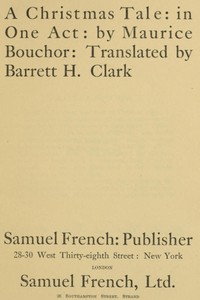
Before opening A Christmas Tale: in One Act — Key Ideas to Explore, the edition data offers a quick orientation: 7,241 words, 32 min estimated reading time, and 1 detected text section.
The text analysis averages about 14.1 words per sentence, while the detected sections provide another way to judge how the source is divided.
Project Gutenberg metadata also associates the work with “Christmas plays,” connecting these edition facts with the source record’s subject description.
Explore this collection
These alternatives are selected using recorded categories and estimated reading time.
About 36 minutes
Fantasy Juvenile Worlds
8,229 recorded words. 4 minutes difference from this book's estimate.
View Gutenberg source #52333About 37 minutes
Fantasy Juvenile Worlds
8,493 recorded words. 5 minutes difference from this book's estimate.
View Gutenberg source #29224About 42 minutes
Fantasy Juvenile Worlds
9,466 recorded words. 10 minutes difference from this book's estimate.
View Gutenberg source #50153Search stored excerpts and compare books → Choose by your preferences →
Choices use stored catalog measurements. Estimates vary with reading speed. A shared category is a catalog label, not a claim that two books have the same argument or literary quality.
Search reads excerpt text stored with this catalog and links to its associated Gutenberg record. The connection is stored in the site database; this tool does not recheck that every excerpt is word-for-word identical to that external record. Excerpt search does not cover every chapter and does not verify historical publication dates.
Catalog snapshot checked: 2026-09-26. Coverage: 90 public books, 90 available source excerpts.
Calculated from edition completeness, EPUB availability, text structure and catalogue metadata. Not a user rating.
Total of 100 points, scaled to a 2.5-5.0 range. Editions with an empty description or a missing EPUB file are not scored.
Public-domain source text
The source text is kept in the dedicated reader, separate from this catalogue record and its commentary.
The play opens with a detailed stage direction that immediately establishes a dual world: a humble Parisian living-room doubling as a sculptor's studio, cluttered with wooden statues and tools, while outside the window the silhouette of Notre Dame and snow-covered roofs are visible. The statues of Saint Nicholas and Saint Rose stand down-stage, played by actors, blurring the line between inanimate objects and living characters. Jacqueline's first lines—'Tis five o'clock, and Pierre is still away'—introduce a note of domestic anxiety, as she fears her husband's weakness will destroy him. The setting, with dying embers, two children's shoes on the hearth, and a sleeping baby in a curtained cradle, creates a tableau of vulnerability and waiting.
The initial stage direction is unusually elaborate for a one-act play, specifying not only the physical arrangement but also the lighting and the actors' dual roles. The statues of Saint Nicholas and Saint Rose are described as 'actors dressed to represent them,' which signals that they may come to life or serve as silent witnesses. The contrast between the sacred (the cathedral silhouette, the saint statues) and the mundane (unfinished statues, scattered chisels) is established from the start. The candle on the mantel and the half-burnt candles on the table suggest a passage of time and a sense of dwindling resources, mirroring Jacqueline's emotional state. This opening tableau invites the reader to pay close attention to how the physical environment reflects the characters' inner lives.
Jacqueline's monologue reveals her fear that Pierre's 'weakness'—likely drinking—will destroy him. She recalls that he was once kind but now neglects her. The play's dialogue, as seen in the excerpt, is in verse, with a formal, slightly archaic quality ('My dear good husband, once so kind, neglects / And leaves me all alone'). This poetic diction contrasts with the gritty domestic setting. The reader should note that Jacqueline's concern is not for herself alone but for Pierre's well-being, suggesting a relationship strained by external pressures. The mention of 'no doubt he sits and drinks' is the only explicit reference to his vice, and it is delivered as a worried speculation rather than a fact. This ambiguity leaves room for the play to develop Pierre's character when he appears.
The presence of Saint Nicholas and Saint Rose as living statues introduces a supernatural element that is typical of Christmas tales but here is grounded in a realistic setting. The stage direction notes that the statues are 'down-stage to the right, close to each other,' positioning them as observers of the human drama. Given the play's title and the season, readers may expect these saints to intervene in the family's crisis. However, the excerpts do not reveal whether they speak or act. The fact that they are played by actors suggests they will at least move or interact. The contrast between the saintly figures and the flawed humans (Jacqueline's worry, Pierre's absence) sets up a potential for redemption or moral lesson. The reader should watch for how the saints' presence shifts the tone from domestic realism to allegory.
The play is set in the fifteenth century, a period of Gothic architecture and religious fervor, evoked by the silhouette of Notre Dame and the mention of church bells striking five. The room itself is a studio, filled with 'wooden statues of various kinds, some painted in bright colors, but most of them unfinished.' This detail suggests Pierre's profession as a sculptor of religious figures, linking his art to the Christmas story. The snow outside and the dying embers inside create a sense of cold and poverty, emphasizing the family's material struggles. The children's shoes on the hearthstone are a traditional Christmas symbol (associated with Saint Nicholas's gift-giving), hinting at the play's resolution. The setting is not merely decorative but integral to the plot, as the statues and the season will likely drive the action.
As you read, note how Bouchor balances the intimate domestic drama with the supernatural promise of the Christmas season. The play's brevity (one act, under 7,300 words) means every detail—from the half-burnt candles to the sleeping child—carries weight. Pay attention to the verse dialogue, which may shift in tone when the saints become active. The translation by Barrett H. Clark preserves the poetic quality while making the play accessible to English-speaking readers. This edition, part of a series of European plays, offers a compact example of late 19th-century French theatrical tradition.
I’ve often thought that Bouchor’s little Christmas play, with its sculptor’s household teetering between miracle and plain worry, shares a quiet kinship with the tangled domestic passions Marston captures. Both books understand that the supernatural rarely arrives loudly—it slips in like a draft under the door, unsettling the everyday. The Works of John Marston. Volume 3 — Background and Themes holds that same old, patient warmth, like a winter hearth remembered.
A brief reflection can help important ideas stay with you longer.