About 123 minutes
Women for votes — Story, Setting & Ideas
Adventure Picaresque Fiction
28,280 recorded words. 7 minutes difference from this book's estimate.
View Gutenberg source #69755
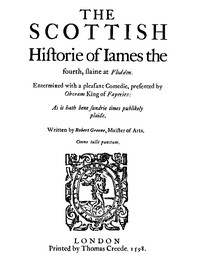
Before opening The Scottish History of James the Fourth 1598 — A Reader’s Guide, the edition data offers a quick orientation: 26,598 words, 1 hr 56 min estimated reading time, and 5 detected text sections.
The text analysis averages about 20.5 words per sentence, while the detected sections provide another way to judge how the source is divided.
Project Gutenberg metadata also associates the work with “Historical drama,” connecting these edition facts with the source record’s subject description.
Explore this collection
These alternatives are selected using recorded categories and estimated reading time.
About 123 minutes
Adventure Picaresque Fiction
28,280 recorded words. 7 minutes difference from this book's estimate.
View Gutenberg source #69755About 105 minutes
Adventure Picaresque Fiction
24,082 recorded words. 11 minutes difference from this book's estimate.
View Gutenberg source #12988About 102 minutes
Adventure Picaresque Fiction
23,442 recorded words. 14 minutes difference from this book's estimate.
View Gutenberg source #53513Search stored excerpts and compare books → Choose by your preferences →
Choices use stored catalog measurements. Estimates vary with reading speed. A shared category is a catalog label, not a claim that two books have the same argument or literary quality.
Search reads excerpt text stored with this catalog and links to its associated Gutenberg record. The connection is stored in the site database; this tool does not recheck that every excerpt is word-for-word identical to that external record. Excerpt search does not cover every chapter and does not verify historical publication dates.
Catalog snapshot checked: 2026-09-26. Coverage: 90 public books, 90 available source excerpts.
Calculated from edition completeness, EPUB availability, text structure and catalogue metadata. Not a user rating.
Total of 100 points, scaled to a 2.5-5.0 range. Editions with an empty description or a missing EPUB file are not scored.
Public-domain source text
The source text is kept in the dedicated reader, separate from this catalogue record and its commentary.
Robert Greene's The Scottish History of James the Fourth (1598) opens not with a king but with Oberon, king of fairies, who introduces a play that will mix historical tragedy with comedy. The surviving quarto, printed by Thomas Creede, presents a text that has clearly been through the press with some care—the title page promises a story of James IV, slain at Flodden, yet the extant play ends before that battle. The excerpts reveal a courtly world where loyalty is tested by ambition: the courtier Ateukin schemes to have Queen Dorothea murdered, while the French servant Iaques, with his macaronic speech, becomes an unwitting accomplice. Greene's language shifts between verse for the nobles and prose for the lower characters, creating a layered social texture.
The excerpts show a sharp contrast between the high-flown rhetoric of the Scottish court and the earthy humor of its servants. Ateukin, a manipulative courtier, flatters the king while plotting against the queen. In one scene, he berates his servant Andrew for losing important writings, leading to a comic exchange where Andrew retorts, “can I loose that you neuer had.” The Frenchman Iaques, speaking a mix of English and French, agrees to stab the queen, saying “me thrusta my weapon into her belle, so me may be gard per le roy.” Greene uses these linguistic contrasts to underscore the gap between noble ambition and base reality.
Queen Dorothea appears as a figure of constancy in a treacherous court. In her scene with Sir Bartram, she insists that “loue the faithfull lincke of loyall hearts” banishes fear, even as she senses danger: “Me thinke no craft should harbour in that brest, / Where Maiestie and vertue is mstaled.” Her language is measured and idealistic, a foil to Ateukin's scheming. The excerpts do not reveal her fate, but her awareness of potential betrayal—that her beauty “should not cause my death”—adds dramatic irony, as the audience knows the plot against her.
The Malone Society reprint, edited by A. E. H. Swaen, preserves the original quarto's inconsistencies: “bog” for “dog,” “a fraid,” “harpe” for “sharp,” and missing speech prefixes for lines 2400–2405. The transcriber's note retains all irregular spelling and punctuation. The play's structure includes choral interludes (five, one per act) and a list of doubtful readings. Readers should note that the text is a diplomatic edition, not a modernized one, and that the leaf A4 is missing from the British Museum copy, supplied by a modern reprint. These details matter for anyone studying the play's transmission.
Greene's play resists easy categorization: it is neither pure history nor pure comedy, but a hybrid that uses the fairy frame to comment on human folly. Readers coming to this edition should attend to the stage directions and speech prefixes, which sometimes blur character identities. The play's incomplete ending—the promised battle of Flodden never appears—leaves the historical narrative suspended, inviting speculation about Greene's original design.
I keep thinking about how Greene’s fairy interlude softens the harsh court politics, like a pause in a heavy conversation. It reminded me of evenings spent over The Game of Chess: A Play in One Act — Edition Insights, where strategy and stillness mingle the same way. Both linger quietly, asking me to sit with their silences rather than rush their outcomes.
Answer a few questions and save a private reflection on this device.