About 127 minutes
He Who Gets Slapped: A Play in Four Acts — Themes and Context
Fantasy Juvenile Worlds
29,035 recorded words. 4 minutes difference from this book's estimate.
View Gutenberg source #37961
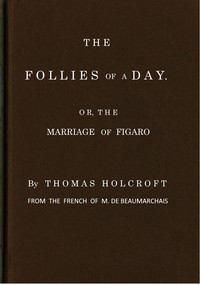
For The Follies of a Day; or, The Marriage of Figaro A comedy, as it is now performing at the Theatre-Royal, Covent-Garden. From the French of M. de Beaumarchais — Themes and Context, the stored edition analysis reports 29,982 words, 2 hr 11 min estimated reading time, and 7 detected text sections.
The text analysis averages about 13.8 words per sentence, while the detected sections provide another way to judge how the source is divided.
Project Gutenberg metadata also associates the work with “Comedy plays,” connecting these edition facts with the source record’s subject description.
Explore this collection
These alternatives are selected using recorded categories and estimated reading time.
About 127 minutes
Fantasy Juvenile Worlds
29,035 recorded words. 4 minutes difference from this book's estimate.
View Gutenberg source #37961About 148 minutes
Fantasy Juvenile Worlds
33,861 recorded words. 17 minutes difference from this book's estimate.
View Gutenberg source #13039About 154 minutes
Fantasy Juvenile Worlds
35,198 recorded words. 23 minutes difference from this book's estimate.
View Gutenberg source #3820Search stored excerpts and compare books → Choose by your preferences →
Choices use stored catalog measurements. Estimates vary with reading speed. A shared category is a catalog label, not a claim that two books have the same argument or literary quality.
Search reads excerpt text stored with this catalog and links to its associated Gutenberg record. The connection is stored in the site database; this tool does not recheck that every excerpt is word-for-word identical to that external record. Excerpt search does not cover every chapter and does not verify historical publication dates.
Catalog snapshot checked: 2026-09-26. Coverage: 90 public books, 90 available source excerpts.
Calculated from edition completeness, EPUB availability, text structure and catalogue metadata. Not a user rating.
Total of 100 points, scaled to a 2.5-5.0 range. Editions with an empty description or a missing EPUB file are not scored.
Public-domain source text
The source text is kept in the dedicated reader, separate from this catalogue record and its commentary.
Thomas Holcroft's 1785 translation of Beaumarchais' The Follies of a Day; or, The Marriage of Figaro was prepared for the Covent Garden stage, and the text bears the marks of that adaptation. The play's dialogue is built on rapid-fire exchanges where characters parry with wit and implication, often speaking aside to the audience while maintaining a polite surface. Holcroft preserves the original's layered diction: servants deploy clever, ironic politeness, while the Count's speech shifts between condescension and frustrated asides. The stage directions, originally in italics and often right-aligned, indicate physical business—a hand on a shoulder, a curtsy, a hesitation—that amplifies the verbal sparring.
The play's dialogue is structured as a series of tactical exchanges. In one scene, Figaro responds to the Count's feigned familiarity—"Appearances, my dear Lord, are frequently false—I am much better than I appear to be"—with an aside that undercuts the compliment: "Take that." This pattern of public deference and private mockery recurs throughout. Susan, when offered the Count's smelling-bottle, refuses with a class-conscious jab: "I the vapours, my Lord! Oh no, that's too polite a disease for a Servant to pretend to!" The Count's replies often reveal his frustration; he mutters "He is too cunning" after Figaro exits, and later calls Susan "a witty little Devil." These asides create a dramatic irony where the audience shares the servants' perspective.
Holcroft's translation retains stage directions that embed physical comedy into the dialogue. The Count's hand on Figaro's shoulder, Susan's curtsy as she delivers her ultimatum—"No Marriage, no Pavilion, my Lord!"—and the Count's "instant change of countenance" all indicate a performance style reliant on gesture. The text marks omitted passages (in inverted commas) that were cut from the Covent Garden production, suggesting a practical trimming for stage time. The transcriber's note mentions that stage directions were often right-aligned with varying indentation, a typographic choice that visually separates action from speech. These details point to a script designed for quick, visible reactions.
The characters' diction reveals their social positions. The Count uses imperatives and possessive language: "thou hast Abilities," "my Gentleman marries Marcelina." Figaro and Susan respond with ironic formality—"Your Lordship is pleased to laugh at me"—that masks defiance. Susan's bargaining line, "And no Marriage, no Pavilion, my Lord!" inverts the Count's threat with a curtsey, using his own logic against him. The play's title, The Follies of a Day, hints at the temporary nature of these power reversals. Holcroft's translation keeps the French original's class-conscious banter, making the servants' wit a form of resistance within the constraints of their roles.
Holcroft, himself a playwright and radical, adapted Beaumarchais for a London audience. His advertisement acknowledges the awkwardness of thanking the public, a self-deprecating tone that mirrors Figaro's own irony. The translation preserves the original's five-act structure but condenses some speeches, as seen in the omitted passages marked by inverted commas. Holcroft's choice of English idioms—"angling for Gudgeons," "valiant Fellow"—naturalizes the French dialogue while keeping its edge. The play's subtitle, "A Comedy, as it is now performing at the Theatre-Royal, Covent-Garden," emphasizes its status as a living script, not a literary text. Readers should attend to these translational choices as clues to the play's stage history.
This edition preserves the play's original typographic quirks—inconsistent parentheses, right-aligned stage directions, and omitted passages—that remind us it is a performance text. Readers interested in the mechanics of 18th-century comedy will find a wealth of detail in the dialogue's rhythm and the stage business encoded in the text. The play rewards attention to what is said aside and what is left unsaid.
Reading Holcroft’s Figaro, I kept thinking how a single line can shift the whole room’s air—that same quiet tension lingers in The Revenge: A Tragedy — A Reader’s Guide. Both feel less like stories and more like echoes of conversations we’ve almost had, the kind you re-hear at night.
Use these questions to collect your thoughts before moving on.