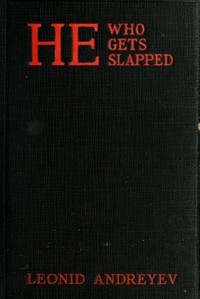
Leonid Andreyev's He Who Gets Slapped opens not with a circus ring but with a Gentleman confronting a figure identified only as HE, whose laughter and mockery dominate the exchange. The Gentleman, a successful author, confesses he is 'deeply, irreparably, and infinitely unhappy' because HE's ideas have been vulgarized and stolen. HE responds with a torrent of scorn, calling the Gentleman a 'tailor of ideas' and a 'great vulgarizer.' This dialogue, dense with accusations of theft and identity, sets the play's tone: a philosophical duel where intellectual property and personal pride are battlegrounds. The catalog lists 'Triangles (Interpersonal relations) — Drama' and 'Clowns — Drama,' but the excerpts show that the central conflict is not romantic rivalry but a war over creative ownership and selfhood, staged within a circus setting that amplifies the grotesque comedy.
The Unnamed Protagonist and His Verbal Violence
The character listed as HE in the dramatis personae—played by Richard Bennett in the 1922 Theatre Guild production—remains nameless throughout the excerpts. He speaks in long, biting speeches that blend philosophical abstraction with personal venom. When the Gentleman claims to be HE's 'shadow,' HE retorts, 'You—my empty shadow.' This exchange reveals a dynamic where HE asserts primacy even as he has supposedly died or disappeared. His language is theatrical in its cruelty: he describes the Gentleman's success as making his thoughts 'comprehensible even to horses' and accuses him of dressing 'my Apollo in a barber's jacket.' The violence is entirely verbal, yet the stage directions—'bursts out laughing,' 'looks at him with curiosity and mockery'—suggest a physical performance of dominance. The catalog subject 'Clowns — Drama' is thus complicated: HE is not a traditional clown but a figure who uses wit as a weapon, and the circus setting may serve as a metaphor for the public spectacle of intellectual life.
The Gentleman's Complaint: A Study in Envy and Identity
The Gentleman, though unnamed in the excerpt, delivers a monologue that inverts the expected power dynamic. He admits to being 'respected' and 'famous,' yet he is consumed by HE's presence: 'Always you! Everywhere you! And I am never alone—never myself and alone.' His grievance is not about lost love but about intellectual and emotional colonization. He claims that even in bed with his wife, they discuss HE's genius, and that his son will resemble HE. This obsession turns the Gentleman into a mirror of HE's own accusations: the 'robber' complains of being robbed. The dialogue circles around themes of originality, influence, and the impossibility of escaping another's shadow. The catalog subject 'Triangles (Interpersonal relations) — Drama' is present only tangentially—the wife is mentioned but never appears—suggesting that the real triangle is between HE, the Gentleman, and the Gentleman's sense of self. The excerpts offer no resolution, leaving the reader to infer how this psychological standoff might play out.
Circus as Frame: The 1922 Production and the Play's Theatricality
The front matter includes a full cast list for the Theatre Guild's 1922 production, directed by Robert Milton with settings by Lee Simonson. The cast includes a lion tamer (Zinida), trapeze performers (Angelica, Estelle), a strong man (Thomas), a snake charmer, a contortionist, and multiple clowns (Tilly, Polly, Jackson). This ensemble suggests that the circus is not merely a backdrop but a functioning world with its own hierarchies. The character HE is listed simply as 'HE,' played by Richard Bennett, while the Gentleman appears only in Act I excerpts. The catalog classifies the work under 'Fantasy & Juvenile Worlds,' yet the dialogue is anything but juvenile: it is dense, ironic, and preoccupied with adult themes of failure, theft, and identity. The play's structure—four acts, with the first act establishing a philosophical confrontation—indicates that the circus may serve as a space where social masks are stripped away, and the 'slap' of the title may be both literal and metaphorical. Readers should attend to how the circus performers interact with HE, as the excerpts do not reveal whether they become his audience, his tormentors, or his fellow outcasts.
The excerpts from He Who Gets Slapped present a play that is less about circus antics than about the corrosive effects of intellectual rivalry. The catalog subjects of clowns and triangles are present but secondary to the central dialogue between HE and the Gentleman, which explores ownership of ideas and the pain of being overshadowed. Readers approaching this work should focus on the verbal sparring and the way Andreyev uses the circus as a stage for existential conflict. The play's four-act structure and the 1922 production details hint at a theatrical experience that balances philosophical weight with physical performance.
I keep thinking about that clown who joined the circus just to be laughed at, and how even the gentlest performers couldn't touch his despair. Something in that ache reminded me of the quiet strangeness in A Select Collection of Old English Plays, Volume 07 — Text and Context, where old voices wrestle with the same lonely questions, almost like distant echoes.