About 228 minutes
Three Wonder Plays — Key Ideas to Explore
Adventure Picaresque Fiction
52,415 recorded words. 12 minutes difference from this book's estimate.
View Gutenberg source #14588
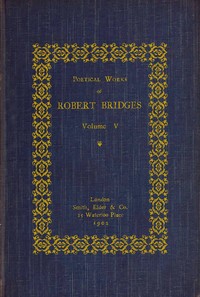
Before opening Poetical Works of Robert Bridges, Volume 5 — Key Ideas to Explore, the edition data offers a quick orientation: 55,163 words, 4 hr estimated reading time, and 23 detected text sections.
The text analysis averages about 11.4 words per sentence, while the detected sections provide another way to judge how the source is divided.
Project Gutenberg metadata also associates the work with “English poetry,” connecting these edition facts with the source record’s subject description.
Explore this collection
These alternatives are selected using recorded categories and estimated reading time.
About 228 minutes
Adventure Picaresque Fiction
52,415 recorded words. 12 minutes difference from this book's estimate.
View Gutenberg source #14588About 261 minutes
Adventure Picaresque Fiction
59,879 recorded words. 21 minutes difference from this book's estimate.
View Gutenberg source #43304About 213 minutes
Adventure Picaresque Fiction
48,821 recorded words. 27 minutes difference from this book's estimate.
View Gutenberg source #55294Search stored excerpts and compare books → Choose by your preferences →
Choices use stored catalog measurements. Estimates vary with reading speed. A shared category is a catalog label, not a claim that two books have the same argument or literary quality.
Search reads excerpt text stored with this catalog and links to its associated Gutenberg record. The connection is stored in the site database; this tool does not recheck that every excerpt is word-for-word identical to that external record. Excerpt search does not cover every chapter and does not verify historical publication dates.
Catalog snapshot checked: 2026-09-26. Coverage: 90 public books, 90 available source excerpts.
Calculated from edition completeness, EPUB availability, text structure and catalogue metadata. Not a user rating.
Total of 100 points, scaled to a 2.5-5.0 range. Editions with an empty description or a missing EPUB file are not scored.
Public-domain source text
The source text is kept in the dedicated reader, separate from this catalogue record and its commentary.
Robert Bridges’s fifth volume of poetical works contains two full-length plays in verse: The Christian Captives, a tragedy in five acts, and Humours of the Court, a comedy in three acts. Despite the catalog subjects ‘English poetry’ and ‘English drama,’ the excerpts show that Bridges is less concerned with lyrical set-pieces than with constructing intricate, psychologically driven dialogue. The opening of The Christian Captives introduces Almeh, the king’s daughter, who expresses wonder at the sea—a detail that immediately establishes her confinement and longing. In Humours of the Court, the Duchess of Belflor manipulates her servant Frederick through a series of pointed exchanges, revealing a power dynamic that drives the plot. Both plays rely on verbal sparring and internal conflict rather than physical action.
In The Christian Captives, the setting is not merely decorative. Almeh’s first speech contrasts the ‘sandy desert’ of Fez with the sea, which she calls ‘the very mountain torrent / Of heaven.’ The castle by the sea becomes a stage for her awakening desire and curiosity. Zapel’s reply—‘Custom will dull the sense of any pleasure’—introduces a theme of perception versus habit. The Christian captives’ singing, heard offstage, is described as ‘sadder than the moaning of the wind,’ and Almeh finds it ‘unearthly.’ Bridges uses the physical environment to externalize the characters’ inner states: the sea represents freedom, the castle confinement, and the captives’ songs a mysterious otherness that Almeh is drawn to but cannot fully understand.
The excerpt from Humours of the Court showcases Bridges’s skill in writing dialogue that advances both plot and character. The Duchess of Belflor and Frederick engage in a tense exchange where every line carries subtext. The Duchess pretends concern for Frederick’s health while forcing him to travel to Milan, thwarting his secret plans. Frederick’s aside—‘Curse on my fate. / How can I escape?’—reveals his helplessness. Bridges uses asides and stage directions sparingly but effectively, letting the dialogue itself convey the power struggle. The Duchess’s command, ‘Deliver it, please, with your own hand,’ is polite but absolute. This scene demonstrates that the comedy’s humor arises from verbal manipulation and thwarted intentions, not slapstick.
The subtitle of The Christian Captives is ‘A Tragedy in a Mixed Manner,’ a phrase that hints at Bridges’s experimental approach. The excerpts do not reveal what ‘mixed manner’ means in practice, but the presence of a chorus of Christian captives suggests classical influence. Meanwhile, Humours of the Court is labeled a comedy, yet its dialogue is sharp and cynical rather than lighthearted. The catalog subjects list both works under ‘English drama,’ but the verse form and the use of a chorus align them with older traditions. Readers expecting straightforward genre pieces will find instead a blend of Elizabethan and Restoration influences, filtered through Bridges’s own formal control. The notes at the end of the volume may clarify his intentions, but the plays stand on their own as intricate character studies.
Readers approaching this volume should set aside expectations of conventional plot-driven drama. Bridges’s plays reward attention to verbal nuance and structural patterning. The two works complement each other: one tragic, one comic, both concerned with confinement—physical, social, or emotional. The excerpts offer only glimpses of the full narratives, but they suggest that Bridges was more interested in the psychology of his characters than in dramatic action. A careful reading of the dialogue, especially the asides and interruptions, will uncover the tensions that drive each play.
There’s something tender about watching Bridges turn a castle prison into a place where minds matter more than walls, and I found myself thinking of that same quiet attention in Percy: A Tragedy—how both pieces listen to their characters rather than rush them. It lingered with me, that unhurried ache. Percy: A Tragedy — Context and Discussion feels like an old friend’s echo.
A brief reflection can help important ideas stay with you longer.