About 508 minutes
"Their Majesties' Servants." Annals of the English Stage (Volume 1 of 3) — Edition Insights
Adventure Picaresque Fiction
116,628 recorded words. 21 minutes difference from this book's estimate.
View Gutenberg source #47116
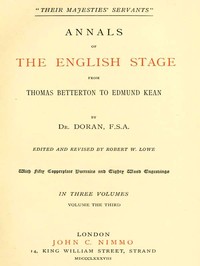
This digital edition of "Their Majesties' Servants." Annals of the English Stage (Volume 3 of 3) — A Reader’s Guide is described by source-level measurements including 121,474 words, 8 hr 49 min estimated reading time, and 28 detected text sections.
The text analysis averages about 20.9 words per sentence, while the detected sections provide another way to judge how the source is divided.
Project Gutenberg metadata also associates the work with “Theater -- Great Britain -- History,” connecting these edition facts with the source record’s subject description.
Explore this collection
These alternatives are selected using recorded categories and estimated reading time.
About 508 minutes
Adventure Picaresque Fiction
116,628 recorded words. 21 minutes difference from this book's estimate.
View Gutenberg source #47116About 565 minutes
Adventure Picaresque Fiction
129,811 recorded words. 36 minutes difference from this book's estimate.
View Gutenberg source #62448About 389 minutes
Adventure Picaresque Fiction
89,420 recorded words. 140 minutes difference from this book's estimate.
View Gutenberg source #5618Search stored excerpts and compare books → Choose by your preferences →
Choices use stored catalog measurements. Estimates vary with reading speed. A shared category is a catalog label, not a claim that two books have the same argument or literary quality.
Search reads excerpt text stored with this catalog and links to its associated Gutenberg record. The connection is stored in the site database; this tool does not recheck that every excerpt is word-for-word identical to that external record. Excerpt search does not cover every chapter and does not verify historical publication dates.
Catalog snapshot checked: 2026-09-26. Coverage: 90 public books, 90 available source excerpts.
Calculated from edition completeness, EPUB availability, text structure and catalogue metadata. Not a user rating.
Total of 100 points, scaled to a 2.5-5.0 range. Editions with an empty description or a missing EPUB file are not scored.
Public-domain source text
The source text is kept in the dedicated reader, separate from this catalogue record and its commentary.
Doran opens this volume with a chapter on condemned authors, immediately establishing that his stage history is as much about the writers who supplied the theatres as the actors who performed. The tone is wry, anecdotal, and occasionally caustic—he notes that a playwright's fate often depended on the whims of a volatile public. Throughout, he treats the stage as a mirror of broader social tensions, from the riots over new plays to the fashions in prologues and epilogues.
Doran devotes an entire chapter to the phenomenon of Master Betty, the 'Infant Roscius' who captivated British audiences in 1804–5. The account is laced with skepticism: Doran reports that Betty learned and played Hamlet within three days, adding, 'I have small respect for his precocious cleverness.' He documents the frenzy with a journalist's eye—crowds gathering under the Piazza at ten in the morning, a playbill warning that no person 'coming from the theatre will be stopt till after eleven o'clock' due to political unrest. The hysteria crossed class lines: duchesses caressed the boy, and the playwright Home wept at his performance of Douglas. Yet Doran also records the dissenters—the Dublin wits who 'showered epigrams,' the Glasgow critic who was 'compelled to leave the city' for a severe philippic. The section reveals how a child actor could become a national obsession, with managers offering £50 per night and half a clear benefit.
Chapter II, 'The Audiences of the Last Half of the Eighteenth Century,' shifts focus from the stage to the pit, boxes, and galleries. Doran treats theatregoers as a collective character—volatile, fashion-driven, and quick to riot. He notes the rituals of late arrival, the chatter during performances, and the way applause or hissing could make or break a play. The audience, in his telling, was as much a spectacle as the actors: 'The public are respectfully informed that no person coming from the theatre will be stopt till after eleven o'clock'—a line from a playbill that doubles as a social document. Doran's method is to let such details speak for themselves, building a picture of a world where theatre was a contested public space, not merely entertainment.
In a chapter devoted to 'Stage Costume and Stage Tricks,' Doran catalogs the material culture of Georgian theatre with evident relish. He describes the anachronisms—Roman heroes in wigs, Macbeth in a military uniform—and the gradual push toward historical accuracy led by John Kemble. The section is rich with specific observations: the use of 'trap-doors, flights, and transformations,' the way actors padded their costumes to appear more imposing, and the curious persistence of certain props. Doran's tone is that of a connoisseur who both admires the craft and winces at the absurdities. He notes, for instance, that a famous actor's 'stage tricks'—a particular pause, a gesture—became so expected that audiences would wait for them. The chapter grounds the glamour of performance in the practical decisions of the wardrobe and the workshop.
Doran's Annals is best read as a series of interlocking portraits rather than a continuous narrative. The volume rewards those who dip into chapters on specific actors or topics—the account of Mrs. Siddons, for instance, or the evolution of the prologue. The editor, Robert William Lowe, has added notes and illustrations that supplement Doran's original text without overwhelming it. Readers interested in the social history of theatre will find the chapters on audiences and stage costume especially illuminating.
Dr. Doran’s Annals always felt like a hushed back room, full of old programmes and candle-grease. Reading his tart notes on Kemble’s Roman toga, my mind drifted to that quieter shelf, where A Select Collection of Old English Plays, Volume 02 — Inside the Classic sits, patient. Both volumes breathe the same dusty air, sharing a fond, crotchety love for vanished voices.
Create a short personal record of your experience with this book.