About 485 minutes
A Select Collection of Old English Plays, Volume 06 — Story, Setting & Ideas
Science Fiction Utopias
111,376 recorded words. 17 minutes difference from this book's estimate.
View Gutenberg source #9848
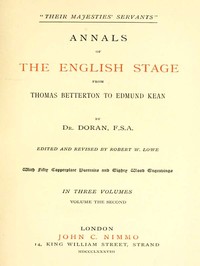
The source record for "Their Majesties' Servants." Annals of the English Stage (Volume 2 of 3) — A Closer Reading measures this digital text at 107,600 words, 7 hr 48 min estimated reading time, and 30 detected text sections.
The text analysis averages about 20.6 words per sentence, while the detected sections provide another way to judge how the source is divided.
Project Gutenberg metadata also associates the work with “Theater -- Great Britain -- History,” connecting these edition facts with the source record’s subject description.
Explore this collection
These alternatives are selected using recorded categories and estimated reading time.
About 485 minutes
Science Fiction Utopias
111,376 recorded words. 17 minutes difference from this book's estimate.
View Gutenberg source #9848About 514 minutes
Science Fiction Utopias
118,214 recorded words. 46 minutes difference from this book's estimate.
View Gutenberg source #44065About 523 minutes
Science Fiction Utopias
120,216 recorded words. 55 minutes difference from this book's estimate.
View Gutenberg source #26146Search stored excerpts and compare books → Choose by your preferences →
Choices use stored catalog measurements. Estimates vary with reading speed. A shared category is a catalog label, not a claim that two books have the same argument or literary quality.
Search reads excerpt text stored with this catalog and links to its associated Gutenberg record. The connection is stored in the site database; this tool does not recheck that every excerpt is word-for-word identical to that external record. Excerpt search does not cover every chapter and does not verify historical publication dates.
Catalog snapshot checked: 2026-09-26. Coverage: 90 public books, 90 available source excerpts.
Calculated from edition completeness, EPUB availability, text structure and catalogue metadata. Not a user rating.
Total of 100 points, scaled to a 2.5-5.0 range. Editions with an empty description or a missing EPUB file are not scored.
Public-domain source text
The source text is kept in the dedicated reader, separate from this catalogue record and its commentary.
Dr. Doran opens this volume with a detailed account of Mrs. Oldfield, but the excerpts quickly reveal a method that is more biographical than theatrical. The narrative follows actors' careers through personal anecdotes, such as Colley Cibber's opportunistic rise: he learns Lord Touchwood in hours, mimics Dogget's Fondlewife to public delight, and parlays a prologue into a guinea tip. Doran's voice is wry and judgmental, calling Cibber 'ever vigilant and ever ready' and noting that his schoolfellows' envy mirrored later actors' resentment. This is not a dry chronology but a gallery of personalities, each chapter named after a star performer.
The excerpts rely heavily on actors' own memoirs—Cibber's Apology is quoted at length—and on Doran's inferences from those accounts. When describing Cibber's triumph as Fondlewife, Doran writes that the house was 'in an uproar of delight and perplexity,' but the only source is Cibber's own claim. Doran does not cross-check with reviews or box-office records. This makes the narrative vivid but fragile: we learn how Cibber wanted to be seen, not necessarily how he was seen. The editor, Robert William Lowe, added portraits and revised the text, but the underlying method remains anecdotal. Readers should treat Doran's confident assertions—'his success was perfect'—as one voice among many.
Doran repeatedly frames theatrical success as a matter of personal ambition and social maneuvering. Cibber's story is a template: he seizes opportunities, endures envy, and converts a manager's 'very ingenious young man' into a career. The phrase 'more suo' (in his usual way) becomes a refrain. Doran notes that Cibber 'little recked what men thought of him, provided only the thought helped him towards fortune.' This psychological portrait extends to other actors: Garrick, Quin, and Barry are introduced through rivalries and patronage. The stage is a battlefield of egos, not an art form. Doran's sympathy lies with the strivers, but he never lets the reader forget the cost—Cibber's wife 'danced round him for joy at this glimpse of Golconda,' a detail that humanizes the grind of low salaries.
Despite its title, Annals of the English Stage, the book is not a comprehensive history. The excerpts cover only a few decades (roughly 1690–1750) and focus on London's patent theatres. Provincial companies, female playwrights, and non-star actors are absent. Doran mentions 'the audiences of 1700–1750' in a chapter title, but the excerpts show no analysis of audience demographics or taste. The catalog subjects—'Theater — Great Britain — History' and 'Actors — Great Britain'—are accurate but misleadingly broad. This volume is a series of biographical sketches, not a survey. Readers seeking the full context of 18th-century theatre should supplement with works like The London Stage or Allardyce Nicoll's histories.
Doran's prose rewards those who enjoy character-driven history, but his reliance on actors' self-reports demands caution. The volume is best read as a companion to primary sources, not a replacement. Lowe's edition includes extensive notes and illustrations that hint at a more scholarly apparatus, but the text itself remains a Victorian raconteur's performance. Approach it as you would a memoir—with pleasure, and with questions.
Reading Dr. Doran’s tales of Garrick’s restless energy makes me think of my grandmother’s old playbills, faded yet fierce. She’d whisper about actors selling their souls for a night’s applause. It reminded me of A marvelous history of Mary of Nimmegen Who for more than seven year lived and had ado with the devil — Key Ideas to Explore, where a woman’s bargain felt less like damnation and more like a quiet, desperate need to be seen on any stage at all.
Use these questions to collect your thoughts before moving on.