About 624 minutes
Richard Steele Edited, with an Introduction and Notes by G. A. Aitken — A Closer Reading
Science Fiction Utopias
143,307 recorded words. 30 minutes difference from this book's estimate.
View Gutenberg source #55922
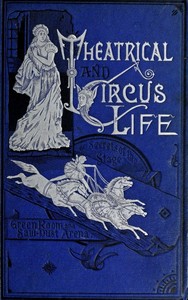
For Theatrical and Circus Life or, Secrets of the Stage, Green-Room and Sawdust Arena — Text and Context, the stored edition analysis reports 150,216 words, 10 hr 54 min estimated reading time, and 50 detected text sections.
The text analysis averages about 23.8 words per sentence, while the detected sections provide another way to judge how the source is divided.
Project Gutenberg metadata also associates the work with “Theater -- United States,” connecting these edition facts with the source record’s subject description.
Explore this collection
These alternatives are selected using recorded categories and estimated reading time.
About 624 minutes
Science Fiction Utopias
143,307 recorded words. 30 minutes difference from this book's estimate.
View Gutenberg source #55922About 567 minutes
Science Fiction Utopias
130,239 recorded words. 87 minutes difference from this book's estimate.
View Gutenberg source #63624About 523 minutes
Science Fiction Utopias
120,216 recorded words. 131 minutes difference from this book's estimate.
View Gutenberg source #26146Search stored excerpts and compare books → Choose by your preferences →
Choices use stored catalog measurements. Estimates vary with reading speed. A shared category is a catalog label, not a claim that two books have the same argument or literary quality.
Search reads excerpt text stored with this catalog and links to its associated Gutenberg record. The connection is stored in the site database; this tool does not recheck that every excerpt is word-for-word identical to that external record. Excerpt search does not cover every chapter and does not verify historical publication dates.
Catalog snapshot checked: 2026-09-26. Coverage: 90 public books, 90 available source excerpts.
Calculated from edition completeness, EPUB availability, text structure and catalogue metadata. Not a user rating.
Total of 100 points, scaled to a 2.5-5.0 range. Editions with an empty description or a missing EPUB file are not scored.
Public-domain source text
The source text is kept in the dedicated reader, separate from this catalogue record and its commentary.
Jennings opens his 1886 volume with a promise to reveal the mechanical and artistic secrets behind theatrical and circus spectacles, positioning his work as a bridge between performers and a public often suspicious of stagecraft. The prologue immediately establishes a defensive tone, arguing that what appears as “blackest diabolism” is merely “the result of the simplest combinations of mechanical skill and studied art.” This framing recurs throughout the excerpts, where Jennings repeatedly insists on the innocence and ingenuity behind illusions that mystify audiences.
The book’s organization mirrors its subject: a series of discrete “secrets” presented in numbered or titled sections, each focusing on a specific technique or performer. The excerpts show a pattern of moving from general explanation to specific anecdote, as when Jennings describes the debut of Emma Livry at the Paris Opera, then pivots to a broader discussion of child training. This modular structure allows readers to dip into topics like trapdoor mechanisms or minstrel-show origins without reading linearly. The text’s 50 sections and 150,000-word length suggest an encyclopedic ambition, yet the prose remains anecdotal rather than systematic.
Jennings repeatedly uses imagery of exposure—the “paint off” faces of performers, the “atmosphere of glory” departed—to underscore the gap between onstage glamour and offstage reality. The child actress Little Corinne is described as “overtaxed far beyond her years,” her performance “more painful than pleasant.” This motif extends to the debutante’s “suspense, frightful” and the “cold, stern critics” ready to puncture her. Even the circus ring, with its sawdust and tented enclosure, is presented as a space where physical risk is constant, though the excerpts focus more on theatrical than circus dangers.
The text frequently shifts between the enclosed world of the theatre and the broader society that judges it. Jennings compares the sins of actors to those of preachers and lawyers, arguing that individual failings should not condemn an entire profession. He also traces the movement of performers from childhood training to public debut, as with the Paris Opera girls “taken at the age of four years” and kept in constant practice. This vertical movement—from obscurity to fame, from backstage to footlights—structures many of the anecdotes, creating a sense of precarious ascent.
Jennings adopts the persona of a knowledgeable insider, using phrases like “I think” and “it is to those whose infant eyes open almost upon the mysteries” to assert authority. He addresses the reader directly, promising to bring “the player and the people into closer relations.” Yet the excerpts also reveal a moralizing streak: he praises the Society for the Prevention of Cruelty to Children for removing Little Corinne from the stage, and he dismisses her as “nothing very clever.” This blend of advocacy and condescension suggests a complex attitude toward the very performers he seeks to defend.
Throughout the excerpts, Jennings uses descriptions of stage machinery to counter accusations of immorality. By explaining how transformation scenes and illusions work, he aims to strip them of any sinister aura. The prologue’s contrast between “deep mystery” and “simple combinations” sets up a recurring rhetorical move: reveal the trick, then assert its innocence. This pattern is most explicit in the discussion of child performers, where Jennings argues that overwork, not stagecraft, is the real danger. The moral argument thus depends on the mechanical one.
Readers should approach this work as a period artifact that blends exposé, memoir, and polemic. Jennings’s voice is that of a defender of the stage, but his defense rests on revealing what others might prefer hidden. The book rewards those who read for its specific technical details—how a trapdoor works, how a dancer trains—rather than for a unified narrative. Its value lies in the texture of its anecdotes and the assumptions it makes about audiences, performers, and the line between illusion and reality.
Reading about trapdoors and transformation scenes, I recalled the summer I spent backstage at a small-town opera house, watching a girl my age vanish through the floor. Later, Richard Steele Edited, with an Introduction and Notes by G. A. Aitken — A Closer Reading gave me that same quiet thrill—finding the hidden seams beneath a polished, public voice, the working wires of sincerity itself.
A brief reflection can help important ideas stay with you longer.