
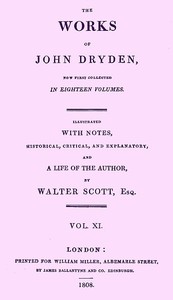
The works of John Dryden, now first collected in eighteen volumes. Volume 11
Before we talk about the plot, let's be clear: this is a volume of collected works, so there isn't one single story. Instead, it's a curated snapshot of Dryden's output from a particular period. You'll find poems, translations, and probably some critical prefaces. Think of it less like a novel and more like a 'selected works' album from a musician, showing off different styles and moods from a key phase in their career. He's writing about the kings and queens of his day, translating classical authors like Virgil or Juvenal, and laying out his own theories about literature and drama. The 'conflict' here is everywhere—in the political poems about a divided nation, in the religious debates he engages with, and in his own artistic struggle to define what great writing should be.
Why You Should Read It
Dryden has a reputation for being formal and difficult, but when you read him in context, he's incredibly direct and sharp. His language is powerful and clear. He's not hiding in flowery metaphors; he's making arguments, defending friends, and attacking enemies. Reading this volume lets you see a first-rate mind processing history as it happens. The themes are huge—what makes a good ruler? How do we find certainty when religions clash? Can old stories from Greece and Rome teach us anything about modern life? Dryden doesn't just ask these questions; he takes a stand. You might not always agree with him (his politics were very much of his time), but you can't help but admire the force and craft of his writing.
Final Verdict
This is not for the casual beach reader. It's perfect for someone who loves history, especially the messy, dramatic 17th century. If you enjoy seeing how poetry and politics intersect, or if you're a writer curious about the foundations of English literary criticism (Dryden is a giant in that field), you'll find this volume incredibly rich. It's also great for anyone who likes their classics with a side of contemporary commentary—his translations are brilliant re-imaginings, not just word-for-word copies. Approach it like you're exploring an archive: dip in, read a poem, read his notes on it, and you'll be rewarded with a vivid connection to the past.
This content is free to share and distribute. Enjoy reading and sharing without restrictions.
Robert Taylor
11 months agoA sophisticated analysis that fills a gap in the literature.
Jessica Miller
4 months agoThe information is current and very relevant to today's needs.
Linda Davis
11 months agoFrom a researcher's perspective, the historical context mentioned in the early chapters is quite enlightening. I'm glad I chose this over the other alternatives.
Margaret Smith
2 months agoComparing this to other titles in the same genre, the structural organization allows for quick referencing of key points. Top-tier content that deserves more recognition.


Paul Garcia
5 months agoThe citations provided are a goldmine for further academic study.