About 46 minutes
The Post Office — Context and Discussion
Science Fiction Utopias
10,413 recorded words. 18 minutes difference from this book's estimate.
View Gutenberg source #6523
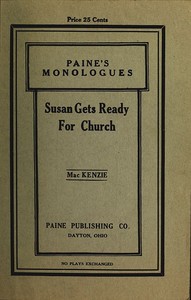
This digital edition of Susan Gets Ready for Church: A Monologue — Edition Insights is described by source-level measurements including 6,288 words, 28 min estimated reading time, and 1 detected text section.
The text analysis averages about 16.3 words per sentence, while the detected sections provide another way to judge how the source is divided.
Project Gutenberg metadata also associates the work with “Young women -- Drama,” connecting these edition facts with the source record’s subject description.
Explore this collection
These alternatives are selected using recorded categories and estimated reading time.
About 46 minutes
Science Fiction Utopias
10,413 recorded words. 18 minutes difference from this book's estimate.
View Gutenberg source #6523About 63 minutes
Science Fiction Utopias
14,351 recorded words. 35 minutes difference from this book's estimate.
View Gutenberg source #72515About 81 minutes
Science Fiction Utopias
18,487 recorded words. 53 minutes difference from this book's estimate.
View Gutenberg source #68434Search stored excerpts and compare books → Choose by your preferences →
Choices use stored catalog measurements. Estimates vary with reading speed. A shared category is a catalog label, not a claim that two books have the same argument or literary quality.
Search reads excerpt text stored with this catalog and links to its associated Gutenberg record. The connection is stored in the site database; this tool does not recheck that every excerpt is word-for-word identical to that external record. Excerpt search does not cover every chapter and does not verify historical publication dates.
Catalog snapshot checked: 2026-09-26. Coverage: 90 public books, 90 available source excerpts.
Calculated from edition completeness, EPUB availability, text structure and catalogue metadata. Not a user rating.
Total of 100 points, scaled to a 2.5-5.0 range. Editions with an empty description or a missing EPUB file are not scored.
Public-domain source text
The source text is kept in the dedicated reader, separate from this catalogue record and its commentary.
Edna I. MacKenzie's Susan Gets Ready for Church: A Monologue (1916) is a single-speaker play that tracks a young woman's morning routine as she dresses for Sunday service. The piece belongs to the genre of monologue performance, published by Paine Publishing Company as part of a series of inexpensive plays and recitations. Rather than advancing a plot, the work builds character through Susan's shifting attention: she frets over a torn glove, admires a hat, recalls a conversation, and scolds herself for daydreaming. The structure mirrors the fragmented, associative logic of a mind in motion, with each object or task triggering a new thought.
The monologue's setting is a single room—likely Susan's bedroom—but the space is crowded with props that compete for her focus. She mentions a "bureau drawer" that sticks, a "hatpin" that pricks her, and a "prayer book" she cannot locate. These objects are not merely functional; they become catalysts for memory and fantasy. A glove with a missing button leads her to recall a young man who once helped her with a similar mishap. The room itself feels like a stage, with Susan moving between mirror, window, and door, each position offering a new angle on her self-presentation. The physical environment is cluttered, and so is her mind: she cannot complete a single task without interruption from her own thoughts.
Susan's speech is marked by frequent self-interruptions and corrections, which reveal her internal conflict between piety and vanity. She begins a sentence about her "soul's salvation" only to break off and adjust her collar. She chides herself for being "worldly" but immediately returns to admiring her reflection. The monologue's rhythm mimics this oscillation: short, breathless phrases give way to longer, more lyrical passages when she describes a song or a memory. The text includes stage directions in parentheses, such as "(looking in mirror)" or "(sighs)," which cue the performer's physical actions. These directions anchor the spoken words in a body that is constantly in motion—adjusting, reaching, turning—so that the voice and the body together create a portrait of restlessness.
Throughout the monologue, Susan's hands are repeatedly mentioned: she "twists" her gloves, "fingers" a ribbon, "smooths" her skirt. These gestures emphasize her anxiety about appearance and her desire for control. Garments themselves become symbols of social performance. She worries that her dress is "too plain" or "too showy," and she debates whether to wear a particular brooch. The act of dressing is not merely practical but ritualistic: each item of clothing must be inspected, adjusted, and approved. The monologue's title, Susan Gets Ready for Church, underscores that the preparation is the event—the church service itself remains offstage. The reader or audience member is left to infer what happens after she leaves the room, but the focus remains on the threshold moment.
Susan's thoughts frequently drift to the world outside her room. She hears a "church bell" in the distance, which reminds her of the time. She imagines the people she will see at church—the "minister," the "choir," a particular young man. These external references pull her away from her immediate tasks, creating a tension between the private space of her room and the public space of the church. The monologue's structure is built on this back-and-forth: she is always on the verge of leaving but keeps returning to the mirror or the bureau. The piece captures the liminal state of being neither fully inside nor outside, neither fully prepared nor ready to go. This oscillation gives the work its dramatic energy, as Susan's departure is perpetually deferred.
Readers approaching this monologue should attend to its performance dimensions: the pauses, gestures, and shifts in tone that the text implies. The work rewards attention to small details—a torn glove, a misplaced pin—that accumulate into a portrait of a young woman negotiating piety, vanity, and social expectation. Because the excerpts are limited, the full arc of Susan's character remains open to interpretation, but the monologue's strength lies in its precise rendering of a mind in the act of preparing itself for the world.
There’s something tender in watching Susan’s restless thoughts circle her Sunday best, each ribbon and button a small plea for composure. It reminds me of another restless soul, finding grit and glory on the Plains of Chippewa. Both seek a steadiness the world keeps interrupting. She Would Be a Soldier; Or, The Plains of Chippewa — Context and Discussion holds that same quiet ache for a self not yet worn in.
Use these questions to collect your thoughts before moving on.