About 223 minutes
I'd Like to Do It Again — Reading Companion
Historical Psychological Social Fiction
51,067 recorded words. 2 minutes difference from this book's estimate.
View Gutenberg source #63287
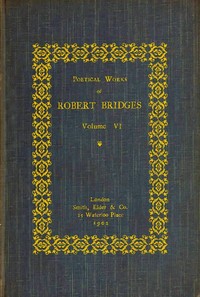
For Poetical Works of Robert Bridges, Volume 6 — Inside the Classic, the stored edition analysis reports 50,729 words, 3 hr 41 min estimated reading time, and 19 detected text sections.
The text analysis averages about 11.9 words per sentence, while the detected sections provide another way to judge how the source is divided.
Project Gutenberg metadata also associates the work with “English poetry,” connecting these edition facts with the source record’s subject description.
Explore this collection
These alternatives are selected using recorded categories and estimated reading time.
About 223 minutes
Historical Psychological Social Fiction
51,067 recorded words. 2 minutes difference from this book's estimate.
View Gutenberg source #63287About 169 minutes
Historical Psychological Social Fiction
38,752 recorded words. 52 minutes difference from this book's estimate.
View Gutenberg source #41242About 297 minutes
Historical Psychological Social Fiction
68,206 recorded words. 76 minutes difference from this book's estimate.
View Gutenberg source #719Search stored excerpts and compare books → Choose by your preferences →
Choices use stored catalog measurements. Estimates vary with reading speed. A shared category is a catalog label, not a claim that two books have the same argument or literary quality.
Search reads excerpt text stored with this catalog and links to its associated Gutenberg record. The connection is stored in the site database; this tool does not recheck that every excerpt is word-for-word identical to that external record. Excerpt search does not cover every chapter and does not verify historical publication dates.
Catalog snapshot checked: 2026-09-26. Coverage: 90 public books, 90 available source excerpts.
Calculated from edition completeness, EPUB availability, text structure and catalogue metadata. Not a user rating.
Total of 100 points, scaled to a 2.5-5.0 range. Editions with an empty description or a missing EPUB file are not scored.
Public-domain source text
The source text is kept in the dedicated reader, separate from this catalogue record and its commentary.
Robert Bridges' sixth volume of poetical works contains two verse dramas that showcase his engagement with classical forms and historical subjects. 'The Feast of Bacchus' is a comedy in the Latin manner, partly translated from Terence, set in a suburb of Athens during a single day. The play opens with Menedemus digging in his garden, ignoring his neighbor Chremes' greeting—a small but telling detail that establishes the play's concern with labor, leisure, and social obligation. Bridges' diction here is deliberately plain, contrasting with the more ornate language of the second play, 'Nero, Part 2,' which dramatizes the conspiracy of Piso against the emperor. The excerpts reveal Bridges' skill in modulating tone between comic and tragic registers.
In 'The Feast of Bacchus,' Bridges does not simply translate Terence but adapts the Latin comedy to his own poetic idiom. The opening exchange between Menedemus and Chremes is brisk and colloquial: 'I only said good morning. I wish you the compliments of the day.' The characters speak in a natural, unforced English that avoids archaism while retaining a formal courtesy. Bridges signals his method in the list of previous editions, where the play is described as 'A Comedy in the Latin manner and partly translated from Terence.' This hybrid approach allows him to preserve the structure of Roman comedy—the single day, the suburban setting, the meddling neighbor—while infusing it with his own metrical and verbal choices. The result is a work that feels both ancient and immediate.
The second play, 'Nero, Part 2,' shifts to a darker, more rhetorical mode. In the excerpts, Seneca counsels Paullina with a speech that balances hope and resignation: 'I shall renounce my wealth, / Place my possessions all in Cæsar's hands, / And stripped to naked, harmless poverty / Fly Rome and power for ever.' Bridges here uses a measured blank verse that conveys Seneca's philosophical composure even under threat. Later, in Act II, the conspirators Senecio, Scevinus, and Quintian speak in a clipped, bitter prose that contrasts sharply with Seneca's elevated verse. Senecio's complaint—'I have played housebreaker and looker on to him these eight years'—reveals a personal grievance that fuels political intrigue. Bridges juxtaposes these registers to highlight the gap between public philosophy and private resentment.
Throughout both plays, Bridges uses diction to distinguish characters and social positions. In 'The Feast of Bacchus,' Chremes' aside—'How fagged he looks!'—is a casual, almost modern phrase that marks his practical, unpoetic nature. In 'Nero,' the emperor's speech is laced with mockery and literary pretension: 'The pale Parnassian reptile, that hath ne'er / Moistened his leathery tongue in Hippocrene.' Nero's bombastic imagery contrasts with the bluntness of Vatinius, who calls himself 'very free / To all the race.' Bridges gives each character a distinct verbal fingerprint, from Seneca's balanced periods to the conspirators' terse complaints. This attention to linguistic detail enriches the drama without overwhelming the action.
Both plays employ tight temporal structures. 'The Feast of Bacchus' is set 'a few hours of one day,' with no pause in the action, adhering to the classical unities. Bridges specifies that 'the whole may be played continuously with a formal break at the end of each act,' emphasizing the play's theatrical practicality. 'Nero, Part 2' covers a longer historical period but concentrates on the conspiracy of Piso, as indicated in the list of previous editions. The excerpts show Bridges compressing events into dramatic scenes: the opening dialogue between Seneca and Paullina, the conspirators' plotting, and Nero's entrance with his favorites. This compression heightens tension and focuses attention on key moments of decision and confrontation.
Readers approaching this volume should attend to Bridges' handling of tone and register across the two plays. The comic and tragic modes are not merely juxtaposed but interwoven through shared concerns with power, obligation, and self-interest. The excerpts offer only partial views of the complete works, but they reveal a poet-dramatist attentive to the nuances of spoken language and the dramatic possibilities of classical form. Those interested in Bridges' development as a playwright will find this volume essential.
It strikes me that Bridges, sifting through Terence and Nero’s court, sought the very pulse of political ambition—how a whispered line can topple a throne. I find a quiet kinship with that old collection of American plays, Representative Plays by American Dramatists: 1856-1911: Introduction and Bibliography — Context and Discussion, for they, too, listened for the nation’s heartbeat in its dialogue. Both were merely eavesdropping on history.
Create a short personal record of your experience with this book.