
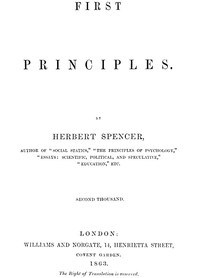
First Principles by Herbert Spencer
Herbert Spencer's First Principles isn't a novel with a plot in the traditional sense. Think of it instead as an intellectual blueprint. Spencer sets out to do something incredibly ambitious: find the fundamental rules that apply to every single thing in the universe. He starts by asking what we can truly know for sure, separating the 'Unknowable' (like the ultimate nature of reality) from what we can study. From there, he builds his entire system.
The Story
The 'story' is the journey of his argument. Spencer proposes that one supreme law governs all existence—the law of evolution. But his definition is broader than just biological change. He describes it as a process where matter moves 'from an indefinite, incoherent homogeneity to a definite, coherent heterogeneity.' In plain English, things start simple and uniform (like a nebula of gas) and become more complex and specialized (like a solar system or a human body). He then shows how this same pattern repeats in the development of societies, languages, and even our minds. The book is his attempt to prove this principle is the master key to understanding science, life, and human history.
Why You Should Read It
You should read this not for easy answers, but for the sheer scale of the thinking. It's humbling and exhilarating to watch someone try to connect all the dots. Spencer's writing, while dense, has a powerful, logical rhythm. Even when I disagreed with his conclusions (and many modern readers will), I admired the architecture of his ideas. It forces you to question your assumptions about progress, order, and how different fields of knowledge relate. Reading it feels like getting a top-down map of 19th-century scientific thought.
Final Verdict
This book is perfect for curious readers who love big-picture, systemic thinking—fans of authors like Yuval Noah Harari or Stephen Hawking's broader works will find a fascinating ancestor here. It's also essential for anyone interested in the history of ideas, sociology, or philosophy. Be warned: it's a demanding read, not a casual one. But if you're willing to engage with a challenging, cornerstone text that tried to explain the world with a single, powerful idea, First Principles is a profoundly rewarding experience.
This digital edition is based on a public domain text. You can copy, modify, and distribute it freely.
Richard Hernandez
7 months agoHaving explored several resources on this, I find that the way it handles controversial points with balance is quite professional. Highly recommended for those seeking credible information.
Barbara Smith
1 month agoSolid information without the usual fluff.
Margaret Williams
11 months agoUnlike many other resources I've purchased before, the quality of the diagrams and illustrations (if applicable) is top-notch. An excellent example of how quality digital books should be formatted.
Michael Perez
2 years agoIt’s rare to find such a well-structured narrative nowadays, the wealth of information provided exceeds the average market standard. Well worth the time invested in reading it.




Charles Gonzalez
1 year agoIt effectively synthesizes complex ideas into a coherent whole.